12 minute reading
Where can you buy Monero without KYC?
You can buy Monero without standard ID verification in two ways: swap crypto you already hold into XMR on a service without accounts, or trade with another person on a peer-to-peer marketplace that accepts bank transfers or cash. Card purchases and exchanges that list XMR usually verify your identity, and swap providers may still run AML checks.
KYC, short for know your customer, is the identity check a regulated platform runs before you can trade or withdraw: a photo ID, a selfie and often proof of address. Monero is a privacy coin: by default, the sender, the receiver and the amount of every transaction are hidden by stealth addresses, ring signatures and RingCT (getmonero.org).
Four kinds of places sell XMR today, and the first three need no account:
Cross-chain swap apps. Symbiosis swaps USDT, ETH, SOL, BTC and other coins into XMR from your own wallet, with no sign-up.
Instant exchanges. FixedFloat, StealthEX, ChangeNOW and dozens of others give you a deposit address and send XMR to your wallet. Aggregators such as Trocador compare them on one screen.
Peer-to-peer marketplaces. RetoSwap, built on the Haveno software, matches buyers and sellers of XMR who pay by bank transfer, payment app or cash.
Exchanges with KYC. Kraken still sells XMR in some regions, though not in the European Economic Area, after you verify your account.
Which exchanges still list Monero?
Few regulated exchanges still list Monero, and the list keeps shrinking. Binance stopped trading XMR on 20 February 2024 (The Block), Kraken closed XMR markets for clients in the European Economic Area on 31 October 2024 (Decrypt), and Coinbase has never listed it (FXStreet). From 10 July 2027, Article 79 of the EU anti-money-laundering regulation bars crypto-asset service providers from keeping anonymous accounts or accounts that allow anonymisation, including through anonymity-enhancing coins such as Monero (EUR-Lex). Owning XMR stays legal; what disappears in the EU is regulated platforms that offer it.
Where Kraken still offers XMR, its buy page says that geographic restrictions apply and that card purchases need an Intermediate or Pro verified account (Kraken).
We priced the same USDT to XMR swap on three services
To compare like with like, we built one route everywhere: 1,000 USDT on Tron (TRC-20) into XMR, on 16 October 2026 between 03:07 and 03:09 UTC. Nothing was sent: each screenshot shows the quote a user sees before paying.
Symbiosis: 1.7531 XMR, signed from your own wallet
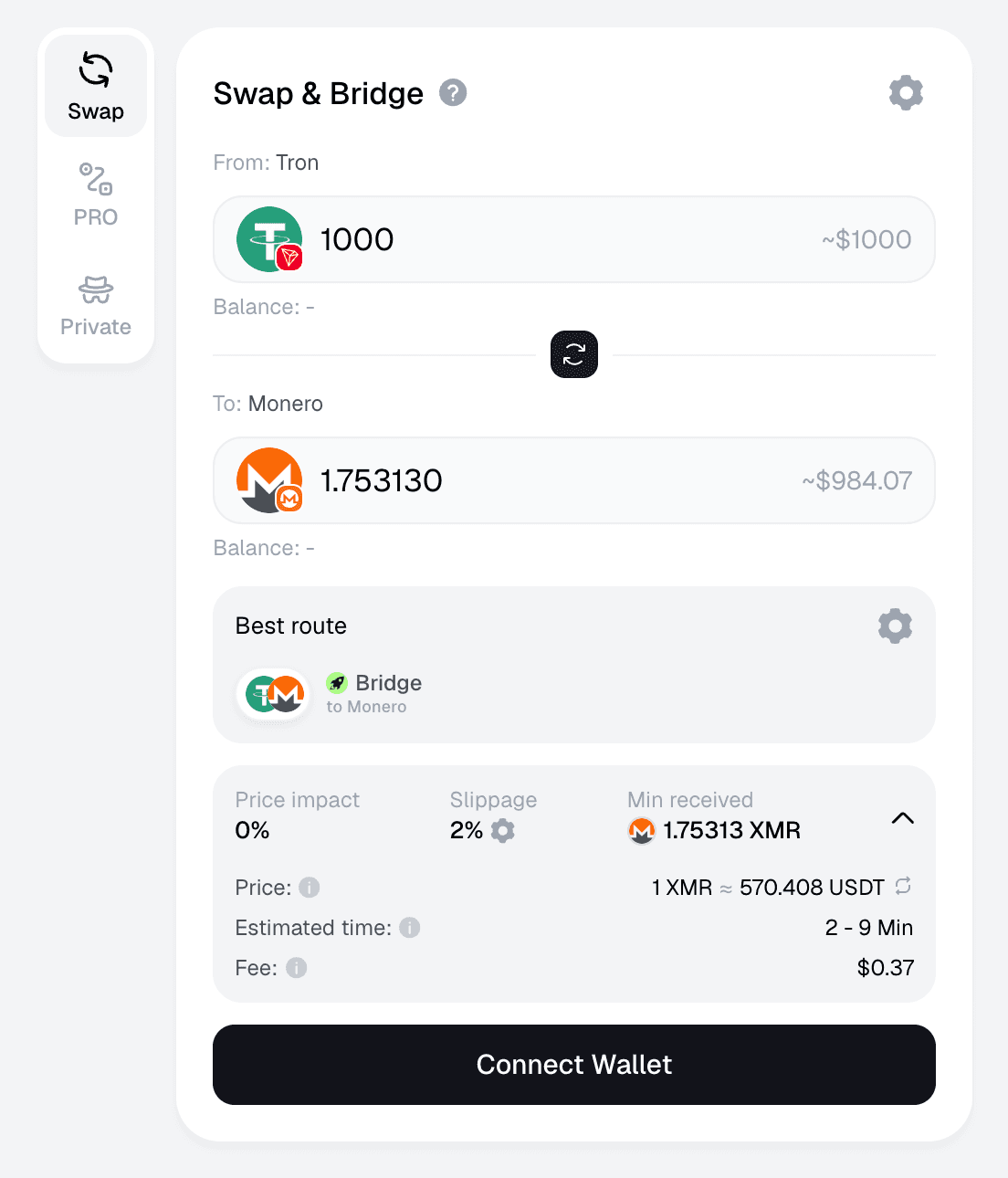
The Symbiosis app quoted 1.753130 XMR for 1,000 USDT at 1 XMR ≈ 570.41 USDT, with an estimated 2–9 minutes, and showed the same figure as the minimum received; the cost of the swap is inside that rate. You see this rate before connecting anything; to swap, you connect a Tron wallet such as TronLink, paste a Monero address and sign one transaction. There is no sign-up. Your wallet also pays the Tron network fee in TRX, up to about 13 TRX for a USDT transfer when it has no staked energy. Depending on the route, a swap may use Symbiosis infrastructure together with external liquidity sources, such as DEXs, pools, aggregators, or partner protocols.
Symbiosis led on speed. Over the 90 days to 15 October 2026, 51 swaps of USDT on Tron into XMR on Symbiosis took 5 minutes 51 seconds at the median, and 90% finished within 10 minutes 39 seconds, measured from the deposit transaction to the payout transaction. Every ETA Trocador showed for its 20 exchanges was longer, 8 to 14 minutes; Trocador says these estimates take each exchange’s recent history into account. The USDT route was also the only one in the test without a manual deposit: the app builds the transfer and you approve it in your wallet instead of copying an address.
Trocador: 20 instant exchanges side by side
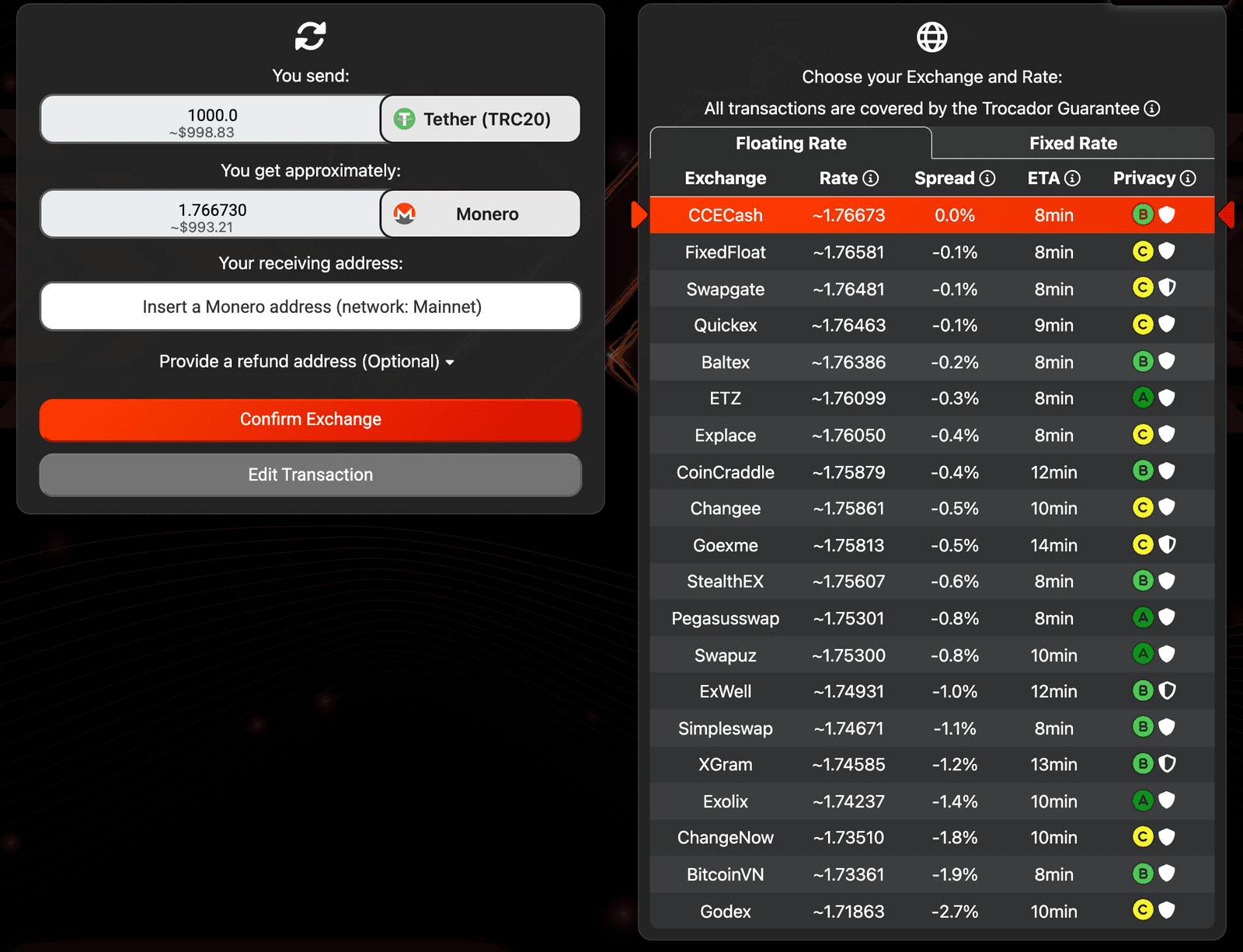
Trocador is an aggregator: it asks partner exchanges for a rate and lists them, and you swap directly with the one you pick. For the same 1,000 USDT, floating-rate estimates ran from 1.76673 XMR at CCECash down to 1.71863 XMR at Godex, a 2.7% spread. FixedFloat quoted 1.76581, StealthEX 1.75607, SimpleSwap 1.74671, Exolix 1.74237 and ChangeNOW 1.73510, with estimated times of 8–14 minutes.
The letter in the last column is Trocador’s KYC rating, from A, no KYC, to D, an exchange that may hold funds until you verify. To set it, Trocador says it reads the exchange’s terms of use and privacy policy, asks how it refunds users who refuse verification and looks at its history on the platform (Trocador FAQ).
FixedFloat: floating or fixed rate
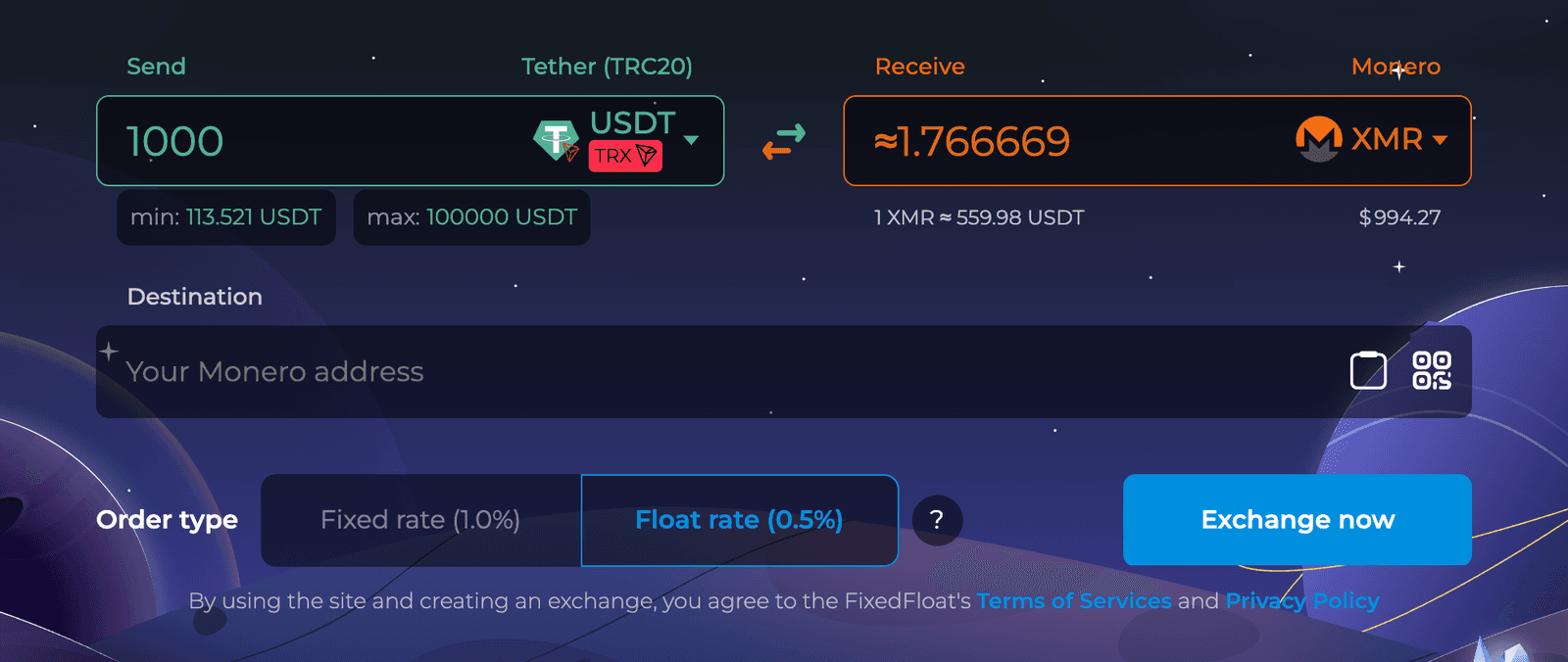
Opening an exchange directly shows the trade-off between rate types. FixedFloat estimated ≈1.766669 XMR at a floating rate with a 0.5% fee and, a few seconds later, 1.757788 XMR at a fixed rate with a 1.0% fee. It set the order limits at 113.521 to 100,000 USDT. Both rates come with conditions: a floating rate becomes final about 10 minutes after your deposit gets its confirmations, and a fixed rate holds only if the deposit reaches the network within 10 minutes of the order and the market moves less than 1.2% before then (FixedFloat terms, sections 2.5 and 2.6). On Trocador’s screen FixedFloat carries a C rating, the lowest in this list, and its terms say a user “may be asked to undergo identity verification” (section 7.9). We opened it as the direct-exchange example because it shows both rate types side by side, not because it is the most private.
What the snapshot shows
Here is the same 1,000 USDT on Tron across the services, within three minutes of each other:
Service | XMR for 1,000 USDT | Rate type | Account | How you pay | Delivery time |
Symbiosis | 1.75313 | Quoted, equals the minimum | No | Sign in your Tron wallet | 5 min 51 s (measured median) |
FixedFloat | 1.75779 | Fixed | No | Deposit address | 8 min (ETA on Trocador) |
FixedFloat | ≈1.76667 | Floating | No | Deposit address | 8 min (ETA on Trocador) |
CCECash via Trocador | ≈1.76673 | Floating | No | Deposit address | 8 min (ETA) |
ChangeNOW via Trocador | ≈1.73510 | Floating | No | Deposit address | 10 min (ETA) |
Symbiosis’s lead was on time and on the manual deposit it skips, not on the rate. The services sat within 2.7% of each other: Symbiosis returned 0.27% less XMR than FixedFloat’s fixed quote, the closest like-for-like, 0.77% less than the best floating estimate at CCECash and 1% more than ChangeNOW’s. Floating figures stay estimates until the deposit confirms.

Buying XMR with Bitcoin
Bitcoin works the same way, with longer waits because the deposit needs block confirmations. Over the 90 days to 15 October 2026, 22 swaps went from Bitcoin into XMR on Symbiosis. Counting from the block that confirmed the deposit to the payout transaction, the median was 12 minutes 30 seconds and 90% finished within 22 minutes; before that, your transaction waits for its first confirmation, which the Bitcoin network decides, not the swap service.
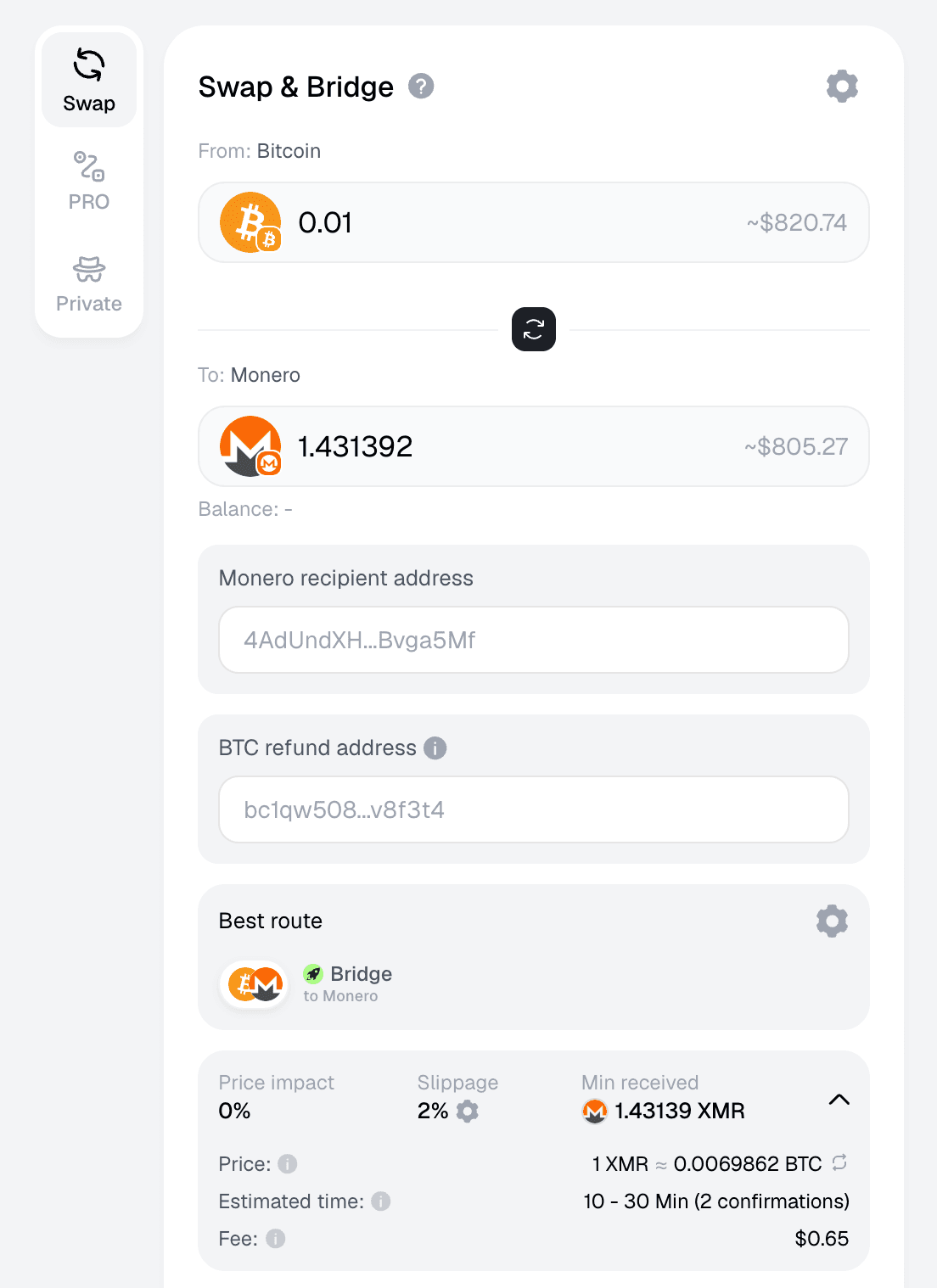
For 0.01 BTC the app quoted 1.431392 XMR at 03:22 UTC, with an estimated 10–30 minutes for two Bitcoin confirmations. With Bitcoin you do not connect a wallet: you enter the Monero address that receives XMR and a BTC refund address, then send BTC to the deposit address the app shows.

On Trocador a minute later, the same 0.01 BTC fetched between 1.44208 XMR at Baltex and 1.37763 XMR at WizardSwap across 24 exchanges, with estimated times from 7 to 57 minutes. ChangeNOW quoted 1.43104 XMR, practically level with Symbiosis, and the median of the 24 quotes was 1.429. See the BTC to XMR page for current rates.
Buying Monero with cash or a bank transfer
To turn dollars or euros into XMR without an ID check, you need a person on the other side of the trade. LocalMonero, the best-known peer-to-peer marketplace for Monero, stopped trading in May 2024 and shut its website in November 2024 (The Block).
Its most visible successor is RetoSwap, a network built on the open-source Haveno software. According to RetoSwap, you install a desktop or Android client that runs over Tor; trades can be paid by SEPA or ACH transfer, apps such as PayPal and Cash App, or cash; disputes go to an arbitrator; fees are 0.1% for makers, 0.8% for crypto takers and 2% for fiat takers; and RetoSwap itself cannot verify identities (RetoSwap). Trades are secured by deposits in XMR, so a buyer who holds no Monero yet should look for the offers RetoSwap marks as no-deposit. It runs only as an installed client, so we did not build a route in it for this article: check the live offers before you trade.
Which option fits which situation
Pick by what you hold and what matters to you:
You want XMR fast and without an account: Symbiosis, which led on speed in our USDT test and shows the route before you sign. Start with USDT to XMR, BTC to XMR or SOL to XMR; our USDT to Monero guide walks through the swap step by step.
You want the highest estimate for a one-off swap: compare instant exchanges on an aggregator, then check the KYC rating of the one you pick.
You need an exact amount of XMR: use a fixed rate, and send the deposit at once: at FixedFloat it holds only if the deposit reaches the network within 10 minutes and the market moves less than 1.2%.
You only have cash or a bank account: a peer-to-peer marketplace such as RetoSwap, which is slower, puts a counterparty between you and the coins and may ask you for an XMR security deposit unless you pick a no-deposit offer.
You already have a verified account where XMR is listed: buy there, knowing the purchase is linked to your identity.
Hidden trade-offs
Five things no quote screen shows you:
No KYC is not never KYC. Trocador warns that partner exchanges “may halt your transaction and demand KYC/AML verification before completing it” and refuse funds with high AML risk.
The paying side stays public. Your USDT, BTC or ETH deposit is visible on its own blockchain, and the swap service keeps a record that links it to your payout. On the Monero chain itself, amounts and addresses stay hidden.
Floating means estimated. The final amount is set after your deposit confirms, so a moving market changes what you receive.
Minimums differ. FixedFloat’s minimum for this route was 113.521 USDT; on Symbiosis, swaps into XMR start at about 20 USDT.
You need a Monero wallet. Feather, Cake Wallet, Monerujo or the official Monero GUI; give each swap a fresh subaddress.

Monero swaps on Symbiosis in numbers
Over the 90 days to 15 October 2026, 278 swaps went into XMR on Symbiosis, worth $2.85 million; the median took 5 minutes 35 seconds and 90% finished within 10 minutes 42 seconds. Here is where they came from and how long they took, from the confirmed deposit to the payout:
Source network | Swaps into XMR | Median time | Within 10 minutes | 90% within |
Tron | 82 | 5 min 30 s | 88% | 10 min 21 s |
Ethereum | 72 | 4 min 36 s | 92% | 9 min 36 s |
BNB Chain | 47 | 5 min 06 s | 87% | 10 min 37 s |
Solana | 30 | 6 min 05 s | 93% | 9 min 10 s |
Bitcoin | 22 | 12 min 30 s | 45% | 22 min 13 s |
Arbitrum One | 11 | 5 min 14 s | 91% | 8 min 22 s |
Bitcoin is the slow one because its deposit needs block confirmations; from the other networks, 87–93% of swaps finished within 10 minutes. Swap sizes varied widely: of the 225 swaps with a dollar value, half were between $460 and $10,000, the median was $2,000, and 34 were under $100. Every one of the 278 swaps into XMR, and of the 267 out of it, was completed with a payout; none is marked in Symbiosis records as pending, stuck or reverted.
How we collected the data
This comparison was produced by Symbiosis. All quotes were taken on 16 October 2026 in a clean browser with no account or wallet connected, without executing any swap: USDT to XMR between 03:07 and 03:09 UTC, BTC to XMR between 03:22 and 03:23 UTC. Symbiosis delivery times are measured on-chain for completed swaps over the 90 days to 15 October 2026, from the deposit transaction to the payout transaction; the times shown for other services are their own ETAs. Rates change every minute, so treat the numbers as a snapshot. For live rates on every pair, see the Monero (XMR) exchange page and the no-KYC crypto exchange overview.

Share this: