9 minute reading
How to buy Zcash: the short answer
You either buy ZEC on a regulated exchange with your ID, or swap crypto you hold into ZEC on a service without accounts. Either way, you then shield it in a Zcash wallet:
Install a Zcash wallet that holds shielded funds, such as Zodl (formerly Zashi) or Zingo!.
Choose the route: an exchange that checks your ID, or a swap from crypto you hold, with no account.
Buy or swap, giving a transparent t1 address if the service cannot pay to a shielded one.
Shield the ZEC in your wallet once it arrives: the amount you shield stays visible, what you do with the coins afterwards does not.
Zcash (ZEC) funds are either transparent or shielded. Transparent funds sit at addresses that start with t and are as public as Bitcoin; shielded funds use zero-knowledge proofs that hide the sender, the receiver and the amount. A unified address, which starts with u1, “is a single address that works across all Zcash pools, transparent and shielded” (z.cash).
Where to buy ZEC with an account
Several regulated platforms list ZEC, and all of them verify your identity first:
Kraken sells ZEC where its licences allow, and card purchases need an Intermediate or Pro verified account (Kraken); it withdraws ZEC to transparent addresses only (ZecHub).
Gemini requires verification before trading (Gemini) and is the exception on withdrawals: it has paid out to unified addresses since August 2025 and routes them to the Orchard shielded pool since November 2025, so ZEC can leave Gemini already shielded (Gemini).
Coinbase lists ZEC and withdraws it to transparent addresses only (ZecHub).
Robinhood listed ZEC for US customers on 24 April 2026 (StartupFortune); it withdraws only to transparent addresses that start with t and does not accept ZEC deposits (Robinhood).
To buy ZEC with dollars or euros, pick an exchange that serves your country, verify your account, fund it by bank transfer or card, place the order, and check which address types it can withdraw to before you move the coins. We did not build routes on these platforms: each one asks for a verified account before it shows an order screen.
We priced the same USDT to ZEC purchase on four services
For a fair comparison we built one route everywhere, 1,000 USDT on Tron into ZEC, on 16 October 2026 between 03:12 and 03:17 UTC. Nothing was sent.
Symbiosis: 0.809068 ZEC, no account
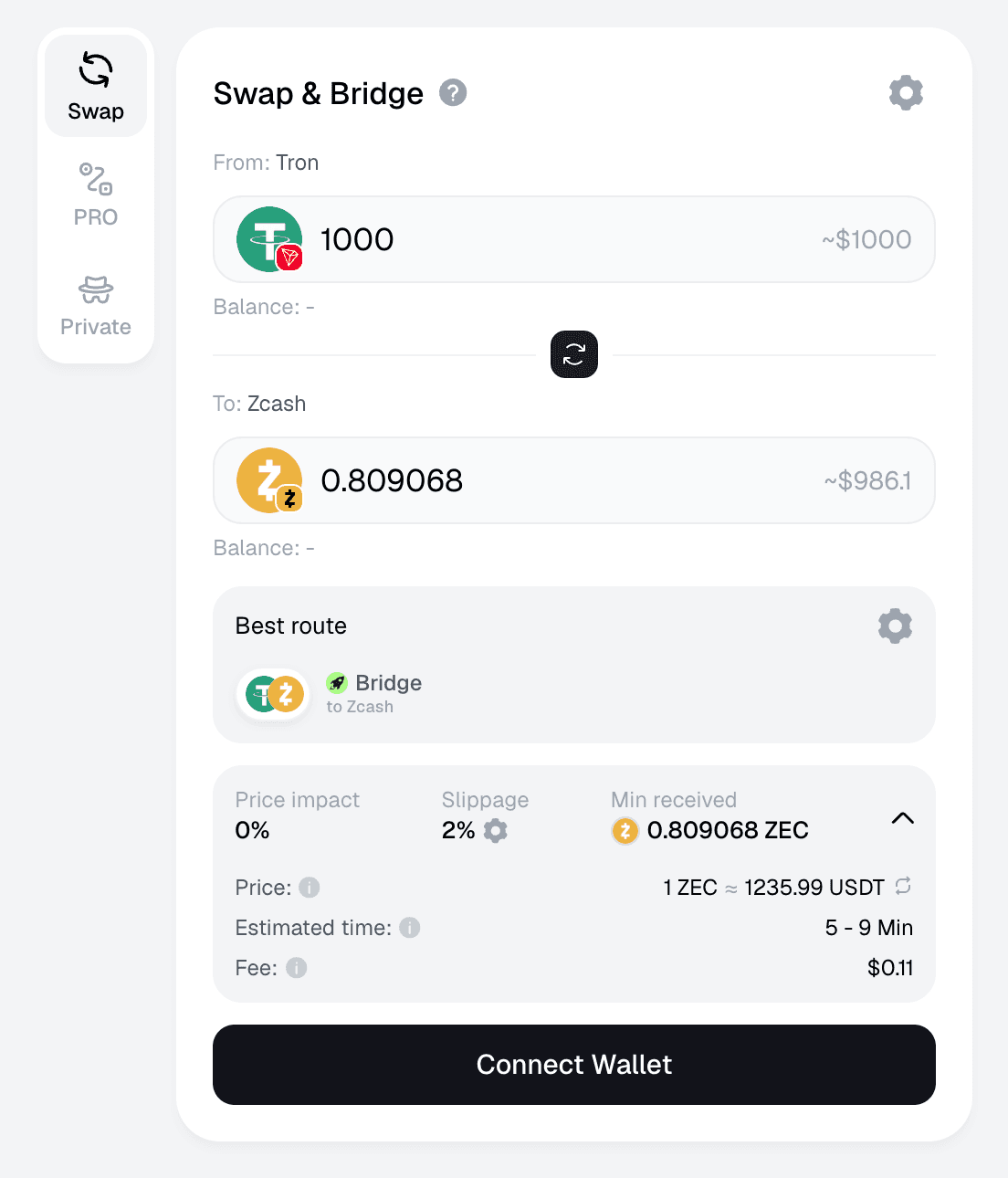
The Symbiosis app quoted 0.809068 ZEC at 1 ZEC ≈ 1,235.99 USDT and estimated 5–9 minutes; the cost is included in the rate. You connect a Tron wallet with a little TRX for the network fee, enter a Zcash address that starts with t1 and sign once. On speed, 68 swaps went into ZEC on Symbiosis over the 90 days to 15 October 2026, mostly from Ethereum (34) and BNB Chain (11): their measured median was 3 min 29 s and nine in ten finished within 6 min 35 s, while 15 of the 16 exchanges on Trocador showed 8–14 minute ETAs. The median covers all source networks, not only Tron. Its displayed minimum received was also 0.19% higher than FixedFloat’s fixed quote. Depending on the route, a swap may use Symbiosis infrastructure together with external liquidity sources, such as DEXs, pools, aggregators, or partner protocols.
near.com: 0.81498 ZEC, an account without KYC
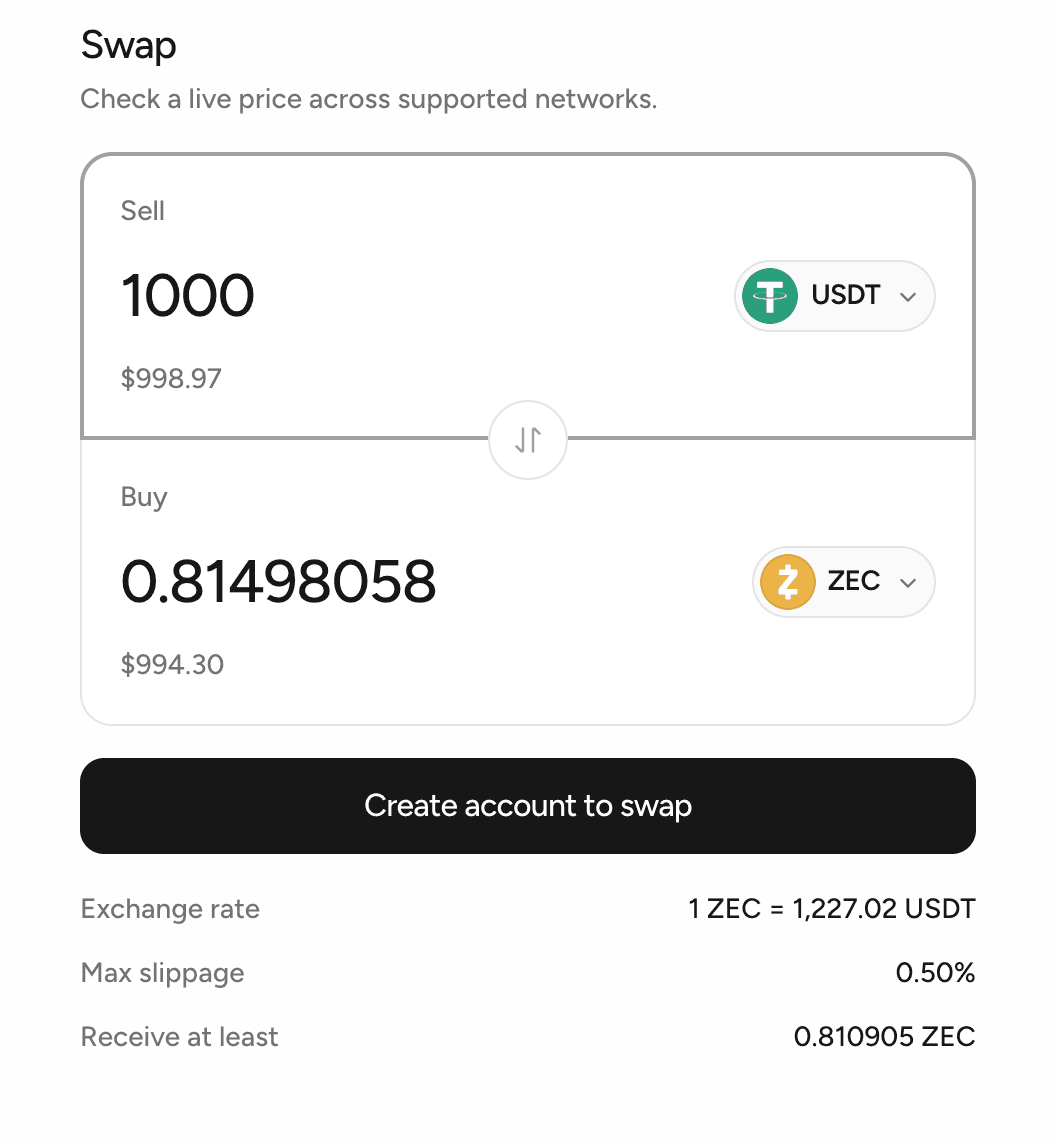
near.com is the app of NEAR Intents, the engine that also powers swaps into ZEC in the Zodl wallet (The Block). Its live demo quoted 0.81498058 ZEC at 1 ZEC = 1,227.02 USDT, with at least 0.810905 ZEC after 0.5% slippage. To swap, you create an account with a passkey or a wallet; the site promises no email and no KYC. The ZEC lands in your near.com balance, and we did not check which Zcash address types it withdraws to.
Trocador: 16 exchanges for transparent ZEC, one for shielded
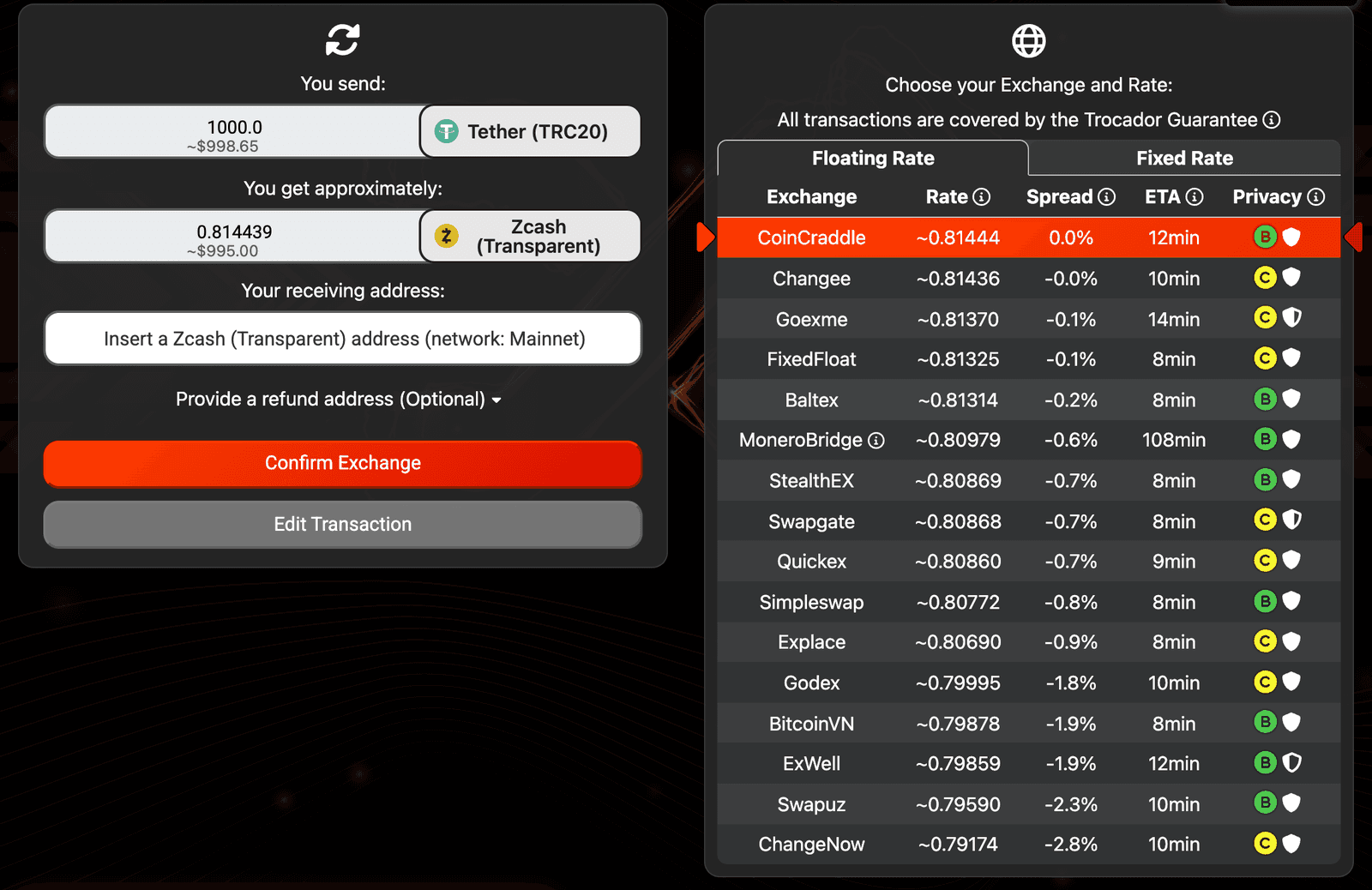
For a transparent payout, Trocador listed 16 exchanges, from 0.81444 ZEC at CoinCraddle down to 0.79174 ZEC at ChangeNOW. FixedFloat quoted 0.81325, StealthEX 0.80869 and SimpleSwap 0.80772; one exchange estimated 108 minutes, the rest 8–14. None of them asks for an account, but Trocador warns that a partner exchange “may halt your transaction and demand KYC/AML verification before completing it”; the letter in its Privacy column rates that risk.
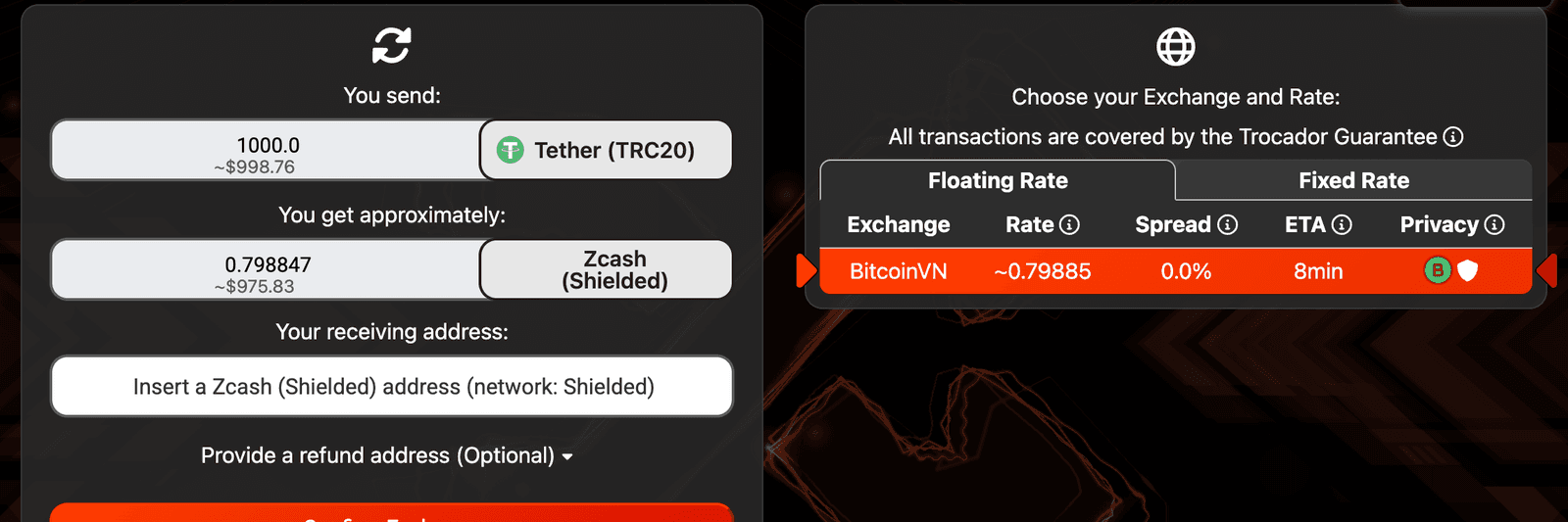
When we asked for delivery to a shielded address, a single exchange answered: BitcoinVN, at 0.79885 ZEC. That is 1.9% below the best transparent quote, but slightly above BitcoinVN’s own transparent quote of 0.79878 ZEC, so the shielded payout itself cost nothing extra.
FixedFloat: fixed and floating
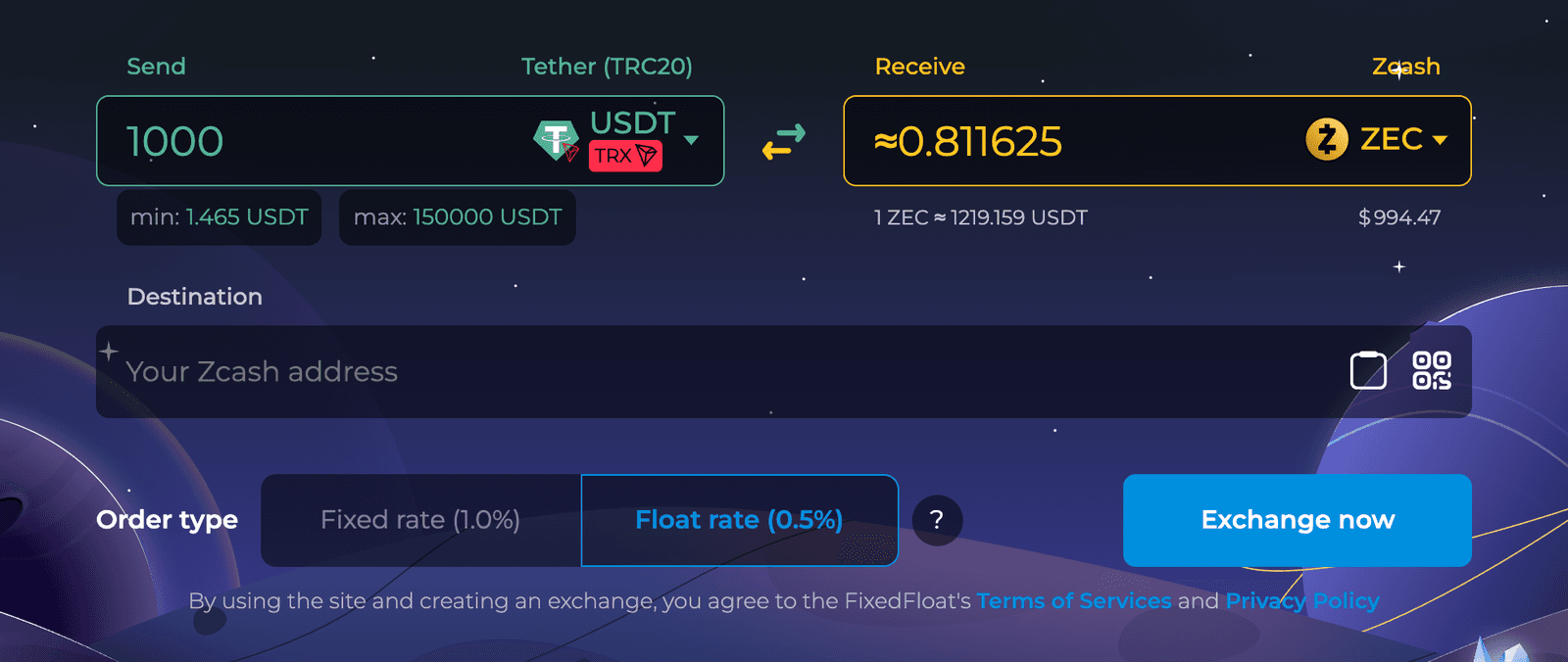
FixedFloat estimated ≈0.811625 ZEC at a floating rate and guaranteed 0.8075446 ZEC at a fixed rate a few seconds later.
Service | ZEC for 1,000 USDT | Rate type | Pays to | Account | Delivery time |
Symbiosis | 0.809068 | Quoted, equals the minimum | Transparent t1 address | No | 3 min 29 s (measured median, all sources) |
near.com | 0.81498 (at least 0.810905) | Slippage 0.5% | near.com account | Yes, no KYC | Not shown |
FixedFloat | 0.807545 | Fixed | Transparent address | No | 8 min (ETA on Trocador) |
CoinCraddle via Trocador | ≈0.81444 | Floating | Transparent address | No | 12 min (ETA) |
BitcoinVN via Trocador | ≈0.79885 | Floating | Shielded address | No | 8 min (ETA) |
The quotes sat within 3% of each other, about 0.023 ZEC or $29 on this amount. Symbiosis led on speed, with a measured median rather than an estimate, and its displayed minimum was above FixedFloat’s fixed quote; near.com gave a bit more ZEC but needs an account. Only BitcoinVN offered a shielded payout, so with any other service shielding is a step you do yourself.

What a transparent ZEC payout looks like on-chain
A transparent payout is readable by anyone, exactly like a Bitcoin transfer. A Zcash block explorer marks it as a public transaction and shows the paying address, the receiving t-address, the amount and the change that went back to the sender.
How to shield ZEC after you buy it
Most services in our test, Symbiosis included, pay ZEC to a transparent address: all 68 swaps into ZEC on Symbiosis in the 90 days to 15 October 2026 paid out to t1 addresses. Shielding moves the coins into a shielded pool, Orchard in current wallets. The shielding transaction still shows the amount and the purchase stays public, but what you do with the coins afterwards does not:
Receive at a transparent address. Copy the t-address from your wallet’s receive screen if the exchange or swap service cannot pay to a shielded or unified address.
Wait for the deposit to confirm. Your wallet shows it as a transparent balance, separate from the shielded one.
Shield the balance. Use your wallet’s shielding option to move the transparent ZEC into the Orchard pool; it costs one small network fee.
Spend from the shielded balance. A payment between two shielded addresses shows nothing on the explorer except that a transaction happened and the fee it paid.
Avoid round trips. The shielding transaction shows how much entered the shielded pool, and moving the same amount straight back out leaves a pattern of amounts and timing that is easy to trace (Nym).
Common mistakes when buying Zcash
Most mistakes with ZEC purchases involve address types:
Pasting a unified (u1…) address where only transparent ones work. Every Symbiosis payout into ZEC in our 90-day window went to a t1 address, so give the app the transparent address from your wallet, not the u1 address most wallets show first.
Leaving ZEC on the transparent balance. Anyone can look up the balance and every transfer of a t-address until you shield it.
Expecting shielded withdrawals from an exchange. Kraken, Coinbase and Robinhood send ZEC only to transparent addresses; among the large exchanges, Gemini is the exception.
Assuming shielded delivery costs extra. At BitcoinVN it did not: 0.79878 ZEC to a transparent address, 0.79885 ZEC to a shielded one. Compare the exchange’s rate, not the address type.
Using an old wallet. Pick one that supports Orchard and unified addresses, such as Zodl or Zingo!.
Zcash wallets to receive and shield ZEC
These wallets hold shielded ZEC:
Zodl, formerly Zashi, from the team that left Electric Coin Company in 2026 (Bitcoinist). Its built-in swap runs on NEAR Intents and, according to Zodl, deposits the ZEC to a fresh shielded address with no account (Zodl).
Zingo!, the wallet z.cash uses in its tutorial for holding funds in Orchard, the newest shielded pool.
Ywallet and Edge, which z.cash also lists among Zcash wallets (z.cash).
Zcash swaps on Symbiosis in numbers
Over the 90 days to 15 October 2026, 68 swaps went into ZEC on Symbiosis. By source network, from the confirmed deposit to the payout:
Source network | Swaps into ZEC | Median time | 90% within |
Ethereum | 34 | 3 min 29 s | 5 min 40 s |
BNB Chain | 11 | 3 min 55 s | 5 min 27 s |
Arbitrum One | 5 | 3 min 15 s | 3 min 48 s |
Solana | 4 | 3 min 50 s | 6 min 23 s |
TON | 4 | 6 min 34 s | 11 min 23 s |
Every swap from Ethereum, BNB Chain, Arbitrum One, Solana, Base and Tron finished within 10 minutes; the two from Bitcoin took 17 min 35 s at the median because of block confirmations. In the other direction, 37 swaps went out of ZEC, with a median of 4 min 33 s. All 105 were completed with a payout.
How we collected the data
Symbiosis prepared this comparison. We opened each service on 16 October 2026 between 03:12 and 03:17 UTC with no account or wallet connected and sent nothing. The Symbiosis figures cover all 68 completed swaps into ZEC in the 90 days to 15 October 2026, timed from the deposit transaction to the payout transaction; the other services’ times are the ETAs they showed. For live quotes, see the Zcash (ZEC) exchange and BNB to ZEC pages.

Share this: