Bridge Base to Solana

Move assets from Base to Solana in about a minute — receive native SOL straight to Phantom, no wrapped tokens, no CEX. 100% on-chain success over 90 days.

Five years of secure cross-chain infrastructure

2021

Live Since

Live Since

2021

50+

Chains

Chains

50+

58 sec

Avg bridge time

Avg bridge time

58 sec

$10B

Total volume

Total volume

$10B

How to bridge Base to Solana

A real case from September 2026: a user bridged 0.5414 ETH from Base and received 12.7396 native SOL in a Phantom wallet via Symbiosis — no wrapped tokens, fully non-custodial. This is one example; you can also bridge USDC and other Base assets to Solana through the same flow. Symbiosis works as a liquidity meta-aggregator on Solana, comparing routes across multiple DEXes and bridge providers and picking the best one by price, fee, and speed automatically. Here's the exact flow:

  1. Picked the source. Base as source, Solana as destination — the ETH sat in a Base wallet and the goal was access to Solana DeFi (Jupiter, Raydium, Kamino).

  2. Connected wallets. MetaMask on the Base side, Phantom on the Solana side. resolved the destination address automatically from the connected Phantom wallet — no manual paste required.

  3. Entered the amount. 0.5414 ETH (~$1,427). The Base wallet’s ETH balance covered network gas (pennies on Base — typically $0.01–0.10 in 2026).

  4. Reviewed the quote. Symbiosis displayed the route (ETH → SOL via the best Solana liquidity source), expected receipt in native SOL, fee, ETA, and price impact upfront. The quote was locked in before signing — 2% slippage tolerance protects against sudden price moves.

  5. Signed and confirmed. Checked the self-custodial wallets confirmation, signed the Base transaction in MetaMask. Native SOL arrived in Phantom within the expected window (~259 sec). The transaction is fixed on-chain — verifiable on Symbiosis Explorer, Basescan and Solscan.
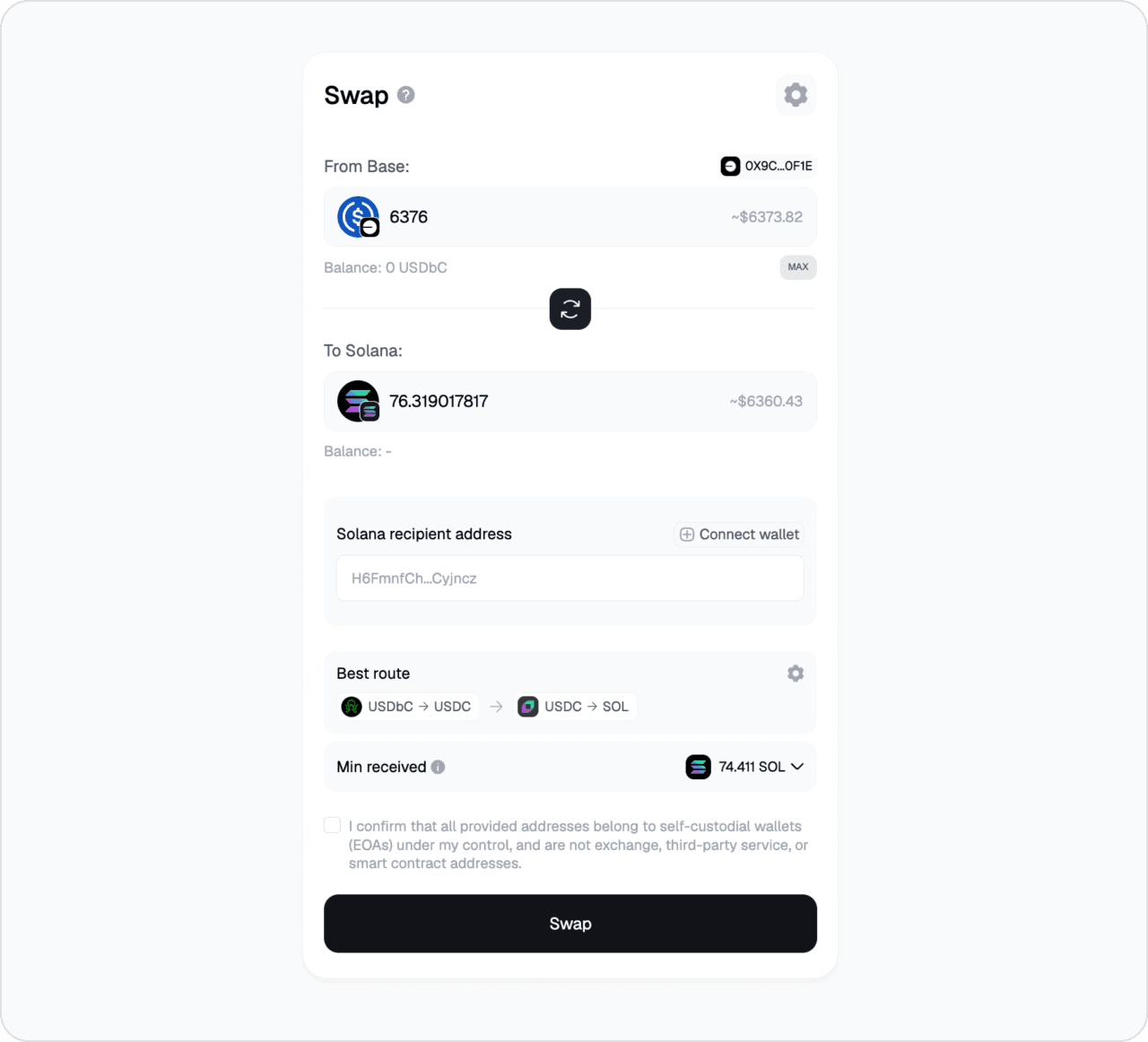
Base to Solana bridge — live route: 6,376 USDbC (Base) → 74.2 SOL (Solana) · Symbiosis

About the Base to Solana route

  • Why this route. Solana's memecoin market runs on SOL: new tokens launch on pump.fun along a bonding curve priced in SOL, and graduates move their liquidity to PumpSwap, pump.fun's own exchange. ETH from Base becomes that SOL.

  • What you receive. Native SOL lands at your Solana address, ready for token buys and fees. You spend ETH on Base and sign one transaction.

  • Watch out for. Pick Base (chain ID 8453) as the source, not Ethereum mainnet, and leave a little ETH there for gas. Phantom holds a Base address and a Solana address in one app; the SOL goes to the Solana one.

  • Speed. Median delivery 3 minutes; 90th percentile 4 minutes, over the 90 days to 25 September 2026.

Related routes: Base Bridge, Base to BNB Chain Bridge, BNB Chain to Solana Bridge, Bridge TON to Solana.

Estimated fees

Approximate fees and swap time based on historical averages, updated 3x/week. Actual values may vary.

Amount

Amount

Amount

Receive

Receive

Receive

Fee + Gas

Fee + Gas

Fee + Gas

Time

Time

Time

0.37 ETH

0.37 ETH

8.383 SOL

8.383 SOL

$3.52

$3.52

~171s

~171s

1.9 ETH

1.9 ETH

43.06 SOL

43.06 SOL

$15.98

$15.98

~171s

~171s

3.7 ETH

3.7 ETH

83.85 SOL

83.85 SOL

$30.89

$30.89

~171s

~171s

9.3 ETH

9.3 ETH

210.5 SOL

210.5 SOL

$76.45

$76.45

~171s

~171s

Ready to bridge? Live rates across
50+ networks. No signup, no KYC

Ready to bridge? Live rates across 50+ networks.
No signup, no KYC

Crypto coins background — Symbiosis blog

Secure by design. Proven at scale

Audited in the open

No KYC, no custody, no intermediaries. Audited by Decurity, Zokyo, SlowMist, and Omniscia — 13 public audit reports across 11 protocol modules (Core, MetaRouter v3, Pool, TON Bridge v1+v2, Relayers Network, Staking, Frontend). All reports open-source on GitHub. 4+ years live on mainnet (since March 2022) with zero major security incidents. Active bug bounty program.

Two-layer staking security

Cross-chain transactions routed via Octopools AMM (scans liquidity across DEXs and chains for minimal slippage), then signed by an MPC group via Threshold Signature Scheme (TSS) — no single party can move user funds. Two security layers: Symbiosis PoS Staking (SIS-collateralised relayer nodes) + Symbiotic restaking (additional slash-able collateral). 2/3 stake quorum for epoch changes.

$8B+ across 54 chains

$8B+ total volume bridged across 5M+ transactions from 800K+ unique wallets. Supports 54 networks — more than any other cross-chain bridge (Across 35+, deBridge 30+, Allbridge 20). EVM + non-EVM in one route — Ethereum, Solana, BNB Chain, TON, Tron, Bitcoin, Arbitrum, Polygon, and 46 more. Per-transaction range: $10 to $140,000 — handles retail swaps and whale trades on the same route.

Still have questions?

Contact us and we’ll help you out.

01

How do I bridge ETH from Base to Solana and receive native SOL?

Connect an EVM wallet (MetaMask, Coinbase Wallet, etc.) to the Symbiosis app, select Base as source and Solana as destination. Choose ETH as input token and SOL as output. Symbiosis delivers native SOL directly to your Phantom or Solflare wallet—no wrapped tokens. Median settlement is about 3 minutes as of September 2026.

02

What are the fees for bridging Base to Solana?

On 25 September 2026, bridging 0.37 ETH from Base to Solana delivered 8.383 SOL with a $3.52 fee, and 9.3 ETH delivered 210.5 SOL with a $76.45 fee. This includes Base gas and the Symbiosis protocol fee; the exchange rate and price impact are already reflected in the amount you receive. If your recipient Solana account is brand new, a one-time rent-exempt activation of ~0.00089 SOL applies, deducted from output.

03

How long does it take to bridge from Base to Solana?

Transfers from Base to Solana take a median of about 3 minutes, with a 90th percentile of about 4 minutes as of September 2026. Speed depends on Base finality, Solana throughput, and liquidity depth—but Symbiosis's multi-hop routing typically resolves fast. Track your transaction live via in-app explorer links.


04

Which wallets work for bridging Base to Solana?

You need two wallets: one EVM wallet for Base (MetaMask, Coinbase Wallet, Rabby, or Trust Wallet) and one Solana wallet (Phantom, Solflare, Backpack, or Trust Wallet in Solana mode). Connect your EVM wallet to initiate the transaction on Base, then paste your Solana receiving address (base58 format) during checkout. Symbiosis routes cross-chain under the hood; you never expose private keys.

05

How does Symbiosis keep funds safe on the Base to Solana route?

Symbiosis is non-custodial: you control your private keys; the protocol uses audited smart contracts and cross-chain messaging (no custodial bridge operators). If a cross-chain operation gets stuck and cannot be completed, Symbiosis reverts it and returns the transit token (for example, a stablecoin) to your address on the source chain.

06

Can I bridge USDC from Base to Solana instead of ETH?

Yes. Symbiosis routes stablecoins such as USDbC on Base through its pools to USDC on Arbitrum One, and the Chainflip bridge then delivers USDC on Solana, or native SOL if you select SOL as output. Bridging a stablecoin skips the ETH to stablecoin conversion on Base; native USDC on Base is first swapped to USDbC. For example, you can bridge USDbC directly from Base and receive native SOL or USDC, depending on your choice. Median fee and settlement times are similar to ETH routes.

07

Why does Symbiosis route Base-to-Solana through multiple tokens?

Symbiosis uses a multi-hop routing layer to optimize liquidity and price. A typical Base to Solana path: ETH to USDbC on Base to USDC on Arbitrum One to SOL on Solana. This three-hop design taps into deep stablecoin liquidity pools on both chains, minimizing slippage and maximizing fill rates. The last hop, from USDC on Arbitrum One to native SOL, runs through the Chainflip bridge. You see one transaction on Base; the protocol handles cross-chain execution transparently.

08

How does Symbiosis compare to other bridges for Base-to-Solana?

Symbiosis delivers native SOL directly, whereas some bridges output wrapped or intermediate tokens requiring extra steps. Under the hood it swaps your ETH to a stablecoin on Base, moves it through its pools to USDC on Arbitrum One and hands the last hop to the Chainflip bridge, so you get native SOL in about 3 minutes at the median as of September 2026. Choose Symbiosis if you want non-custodial, audited, and native-asset delivery.

Two chains. One click

Bridge Base to Solana — native SOL in ~24s, 100% success rate. Start now.

Bridge Base to Solana — Symbiosis banner background
Trending article icon

Bridge USDC, ETH & more to Solana: 5 top options

Moving SOL to ETH or routing ADA and ALGO into Solana isn't always straightforward. We break down where each bridge shines, what they actually cost, and which one fits your route.

Trending article icon

Bridge USDC, ETH & more to Solana: 5 top options

Moving SOL to ETH or routing ADA and ALGO into Solana isn't always straightforward. We break down where each bridge shines, what they actually cost, and which one fits your route.

Quick guide icon

Best crypto bridges: cheapest cross-chain swaps

Bridging fees can quietly eat 5% of your transfer if you pick wrong. We break down how the top cross-chain bridges stack up on real costs, settlement times, and chain coverage so your next DeFi move isn't a gamble.

Quick guide icon

Best crypto bridges: cheapest cross-chain swaps

Bridging fees can quietly eat 5% of your transfer if you pick wrong. We break down how the top cross-chain bridges stack up on real costs, settlement times, and chain coverage so your next DeFi move isn't a gamble.

Cross-chain swap icon

How to bridge to Solana (SOL & USDC) with Symbiosis

Moving funds onto Solana used to mean wrapped tokens and multiple steps. Now you can route a sol bridge from any chain, see real fees, and land native SOL or USDC without the headache.