Bridge ETH to Arbitrum
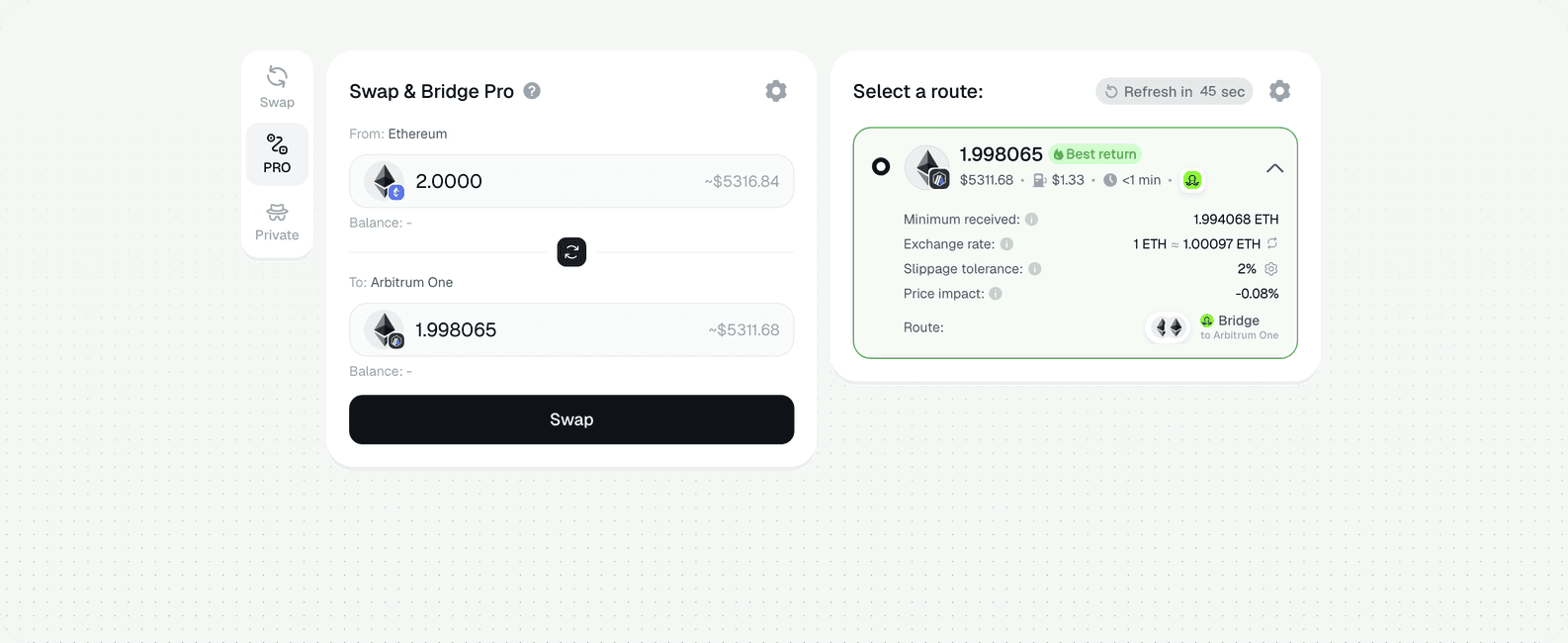
Bridge ETH to Arbitrum One via Symbiosis Octopools AMM. Instant settlement vs 7-day Arbitrum native bridge wait. Non-custodial, no KYC, audited.

Numbers
Proven performance
How to Bridge ETH to Arbitrum
Arbitrum One is an Ethereum L2 that uses ETH as native gas. The official bridge (bridge.arbitrum.io) routes deposits in ~10 minutes but withdrawals take a 7-day fraud-proof window. Symbiosis bypasses that wait with instant routing through Octopools AMM in both directions.
Connect your EVM wallet. MetaMask, Trust Wallet, or Rabby work. The same 0x address handles both Ethereum and Arbitrum One — no separate setup needed.
Select source. Pick Ethereum as source network and ETH as the asset.
Select destination. Choose Arbitrum One and ETH (Arbitrum native gas, not ARB token). Your destination defaults to the connected wallet address.
Review the quote. Check the ETH output on Arbitrum, the Symbiosis fee, and route time. Arbitrum confirmation is ~250ms once the source tx finalizes.
Confirm and sign. Sign the Ethereum source transaction. ETH appears in your Arbitrum wallet shortly after, ready for GMX, Camelot, Aave, or Pendle.

About ETH to Arbitrum route
ETH to Arbitrum is an EVM-to-EVM L2 transfer. The dominant cohort is users moving capital to Arbitrum DeFi (perps, lending, RWAs) without the native withdrawal lock when they want to exit. Symbiosis settles instantly in both directions, while keeping you non-custodial.
Arbitrum gas costs typically run $0.01–$0.30 per transaction post-Stylus, making downstream activity cheap. For a comparison of Arbitrum One vs Nova and the differences that matter, see our guide on Arbitrum One vs Nova.
Other ETH routes
ETH → Base — Coinbase L2, ETH stays as native gas
ETH → Polygon — native POL for low-fee EVM apps
Estimated fees
Approximate fees and swap time based on historical averages, updated 3x/week. Actual values may vary.
Bridge now
Try to swap BNB to SOL
Transfer your ETH to BNB Chain in seconds with the best rates available.

Benefits
Why Symbiosis
FAQs
Got questions?
Still have questions? Contact us and we’ll help you out.
01
Why use Symbiosis instead of the official Arbitrum bridge?
The official Arbitrum bridge (bridge.arbitrum.io) is free for deposits but enforces a 7-day fraud-proof window on withdrawals back to Ethereum. That delay protects the rollup's security model but blocks active capital. Symbiosis routes both deposits and withdrawals through liquidity pools instead of waiting on the rollup's exit window — typical settlement under a minute. The trade-off: a small protocol fee versus 7 days of locked capital.
02
Is ETH on Arbitrum the same as ETH on Ethereum?
Yes — ETH on Arbitrum One is real ETH used as native gas, not a wrapped representation. When you bridge ETH from Ethereum, you receive native Arbitrum ETH (sometimes labeled "ETH-on-Arbitrum" in wallets). It pays for transactions on Arbitrum directly and can be bridged back to Ethereum mainnet ETH 1:1. ARB is a separate governance token, not the gas asset.
03
How fast is bridging ETH to Arbitrum through Symbiosis?
End-to-end settlement is typically 30–90 seconds: Ethereum source confirmation (12–60 seconds depending on congestion) plus Arbitrum block inclusion (~250ms once routed). Compared to ~10 minutes for the official deposit and 7 days for native withdrawal, this is a meaningful speed advantage for active traders.
04
Do I need to add Arbitrum One to MetaMask manually?
Most modern MetaMask versions auto-prompt to add Arbitrum One on first interaction. If not, add manually: Network Name = Arbitrum One, RPC URL = https://arb1.arbitrum.io/rpc, Chain ID = 42161, Currency Symbol = ETH, Block Explorer = https://arbiscan.io. Or use Chainlist.org for one-click setup. Same 0x address works automatically.
05
How much does it cost to bridge ETH to Arbitrum?
Bridging ETH to Arbitrum via Symbiosis includes a Symbiosis protocol fee plus Ethereum source gas. Source gas in current 2026 conditions runs $1–$15 typical (spikes to $30+ during congestion). The protocol fee is shown upfront in the quote — no hidden deductions on the destination side. Routing to Base can be cheaper if you don't specifically need Arbitrum DeFi.
06
What's the difference between Arbitrum One and Arbitrum Nova?
Arbitrum One is the main Arbitrum rollup, secured by Ethereum data availability — used for DeFi, perps, RWAs, and most established protocols. Arbitrum Nova uses AnyTrust technology with a Data Availability Committee, optimized for cheap, high-frequency activity like gaming and social apps. One has higher liquidity and TVL; Nova has lower fees but a different security model. Most ETH bridging traffic targets One.
07
Can I bridge ETH back from Arbitrum to Ethereum without waiting 7 days?
Yes — Symbiosis runs Arbitrum→Ethereum routes through liquidity pools, settling in under a minute regardless of the official 7-day fraud-proof window. You pay a small protocol fee plus destination gas, but you avoid the week-long lock. Useful for active traders managing positions across L1 and L2.
08
Is bridging ETH to Arbitrum via Symbiosis safer than centralized exchanges?
A centralized exchange requires depositing ETH, custody by the exchange, then a separate Arbitrum withdrawal — three custodial steps with KYC, withdrawal limits, and freeze risk. Symbiosis is non-custodial: smart contracts execute the route, your wallet retains signing authority throughout, and there's no signup or identity verification. The trade-off is on-chain transaction risk versus exchange-specific risks like withdrawal blocks or custody loss.
Articles
Related articles

How to Bridge ETH to Arbitrum: Fees, Speed & Best Routes 2026
Step-by-step guide to bridging ETH to Arbitrum. Compare Official Bridge, Across, deBridge, Symbiosis fees and speed. Skip the 7-day wait — bridge in under 2 minutes.
Read article

What Is Arbitrum?
Discover Arbitrum: a Layer-2 solution enhancing Ethereum's scalability with low fees, fast transactions, and robust ecosystem support.
Read article

Best ETH Bridge in 2026: Fees, Speed, and Security Compared
Compare 9 ETH bridges by architecture, fees, speed, and exploit history. Intent-based vs liquidity pool vs lock-and-mint — which is safest in 2026.
Read article
Two chains. One click
Skip the 7-day Arbitrum native withdrawal queue. Instant routing both ways.