Arbitrum Bridge

Bridge any token to and from Arbitrum across 53+ networks — stables (USDT, USDC), ETH, ARB and dozens more — in one non-custodial transaction. Median delivery 31 seconds via Symbiosis routing layer.

Five years of secure cross-chain infrastructure

2021

Live Since

Live Since

2021

50+

Chains

Chains

50+

58 sec

Avg bridge time

Avg bridge time

58 sec

$10B

Total volume

Total volume

$10B

How to bridge to Arbitrum

Example quote from 25 September 2026: sending 3,000 USDC (~$3,000) from Ethereum returns about 1.1166 ETH on Arbitrum One via Symbiosis, estimated ~51 sec — no wrapped tokens beyond the standard route, fully non-custodial. Symbiosis works as a liquidity meta-aggregator, comparing routes across multiple DEXes and bridge providers and picking the best one by price, fee, and speed automatically. Here's how the flow works:

  1. Pick the source. Set Ethereum as source and Arbitrum One as destination — the USDC sits in an Ethereum wallet, and the goal is access to Arbitrum DeFi (GMX, Camelot, Aave).

  2. Connect wallets. MetaMask on the Ethereum side, MetaMask on the Arbitrum One side. Symbiosis reads the destination address automatically from the connected wallet — no manual paste required.

  3. Enter the amount. 3,000 USDC (~$3,000) in this example. Keep enough ETH in the wallet to cover network gas.

  4. Review the quote. Symbiosis displays the exact ETH amount on Arbitrum One (about 1.1166 ETH in this example), the flat Symbiosis fee in USD, and ETA (~51 sec). The quote is locked in before signing — 2% slippage tolerance protects against sudden price moves.

  5. Sign and confirm. Sign the Ethereum transaction in MetaMask. ETH arrives in MetaMask once the route completes — track the transfer on Symbiosis Explorer.
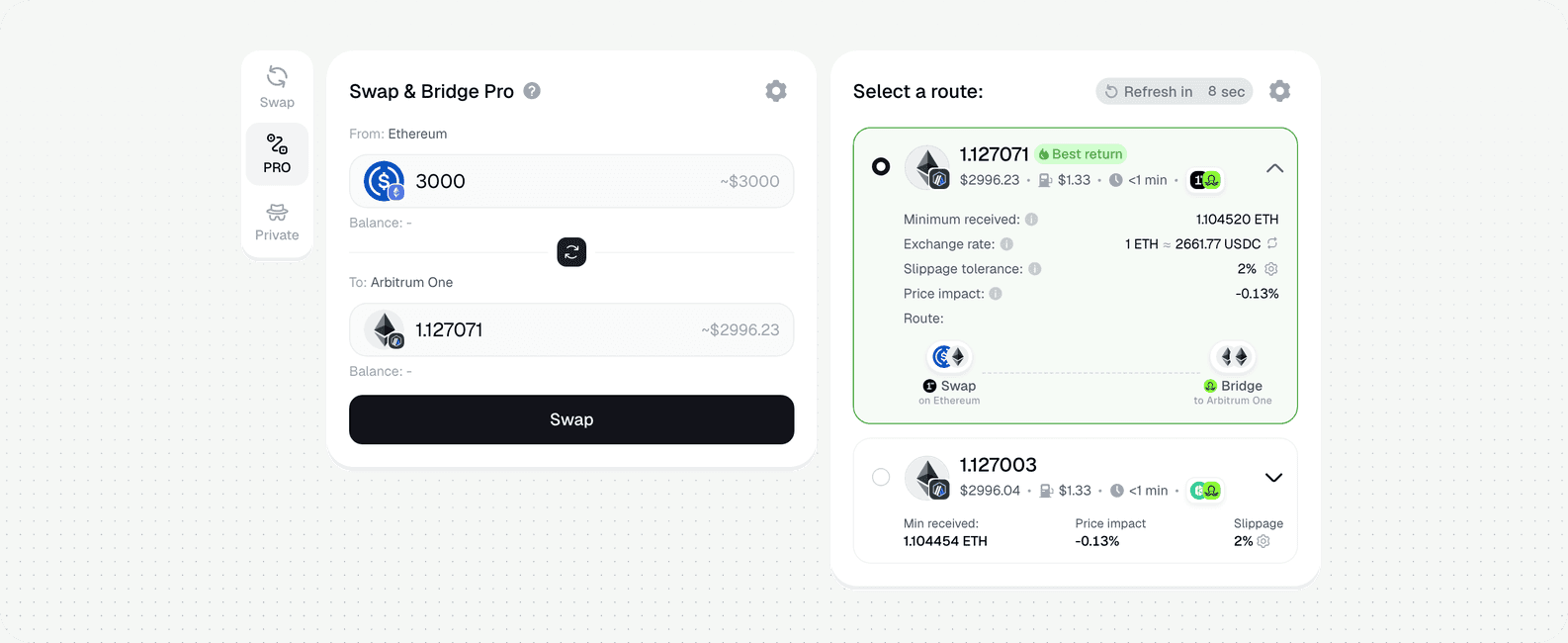
Arbitrum Bridge — live route in PRO mode: 3,000 USDC (Ethereum) to 1.127 ETH (Arbitrum One) · Symbiosis

About bridging to Arbitrum One

  • Why this route. Arbitrum One is where GMX perpetuals, Pendle yield markets and an Aave lending market live, and Hyperliquid's onboarding guide names USDC on Arbitrum as a common way to fund a trading account.

  • What you receive. In the widget example, USDC leaves Ethereum and native ETH arrives on Arbitrum One, ready to pay rollup gas or go into those apps. You sign a single transaction; Symbiosis does the conversion and the crossing.

  • Watch out for. Choose Arbitrum One, chain ID 42161; Arbitrum Nova (42170) is a separate chain with its own balances. The USDC transfer itself is paid for in ETH on Ethereum, so the sending wallet needs some mainnet ETH as well.

  • Speed. Across all routes into Arbitrum One, median delivery 32 seconds; 90th percentile 116 seconds, over the 90 days to 25 September 2026.

Related routes: Solana to Arbitrum One Bridge, BNB Chain to Arbitrum One Bridge, Optimism to Arbitrum Bridge, Arbitrum to Base Bridge.

Estimated fees

Approximate fees and swap time based on historical averages, updated 3x/week. Actual values may vary.

Amount

Amount

Amount

Receive

Receive

Receive

Fee + Gas

Fee + Gas

Fee + Gas

Time

Time

Time

1,000 USDC

1,000 USDC

0.3761 ETH

0.3761 ETH

$7.76

$7.76

~73s

~73s

2,500 USDC

2,500 USDC

0.9424 ETH

0.9424 ETH

$12.22

$12.22

~73s

~73s

5,000 USDC

5,000 USDC

1.884 ETH

1.884 ETH

$26.14

$26.14

~73s

~73s

10,000 USDC

10,000 USDC

3.77 ETH

3.77 ETH

$44.81

$44.81

~73s

~73s

Ready to bridge? Live rates across
50+ networks. No signup, no KYC

Ready to bridge? Live rates across 50+ networks.
No signup, no KYC

Secure by design. Proven at scale

Audited in the open

No KYC, no custody, no intermediaries. Audited by Decurity, Zokyo, SlowMist, and Omniscia — 13 public audit reports across 11 protocol modules (Core, MetaRouter v3, Pool, TON Bridge v1+v2, Relayers Network, Staking, Frontend). All reports open-source on GitHub. 4+ years live on mainnet (since March 2022) with zero major security incidents. Active bug bounty program.

Two-layer staking security

Cross-chain transactions routed via Octopools AMM (scans liquidity across DEXs and chains for minimal slippage), then signed by an MPC group via Threshold Signature Scheme (TSS) — no single party can move user funds. Two security layers: Symbiosis PoS Staking (SIS-collateralised relayer nodes) + Symbiotic restaking (additional slash-able collateral). 2/3 stake quorum for epoch changes.

$8B+ across 54 chains

$8B+ total volume bridged across 5M+ transactions from 800K+ unique wallets. Supports 54 networks — more than any other cross-chain bridge (Across 35+, deBridge 30+, Allbridge 20). EVM + non-EVM in one route — Ethereum, Solana, BNB Chain, TON, Tron, Bitcoin, Arbitrum, Polygon, and 46 more. Per-transaction range: $10 to $140,000 — handles retail swaps and whale trades on the same route.

Still have questions?

Contact us and we’ll help you out.

01

What is the cheapest way to bridge to Arbitrum?

On the Ethereum to Arbitrum route the fee grows with the amount you move. On 28 September 2026, bridging 1,000 USDC delivered 0.3761 ETH on Arbitrum with a $7.76 fee (full cost in the Symbiosis app plus gas), and 10,000 USDC delivered 3.77 ETH with a $44.81 fee; the exchange rate is already reflected in the amount you receive. Comparable to or cheaper than most cross-chain routers because there are no intermediate wrap/unwrap steps; one source-chain transaction does the whole route.

02

Is the Arbitrum network safe?

Arbitrum One is an optimistic rollup secured by Ethereum mainnet with a 7-day fraud-proof window — the same security model used by most major L2s. Symbiosis interacts with Arbitrum non-custodially through audited smart contracts; user funds are never held by Symbiosis or any centralized intermediary. Every transaction is verifiable on Arbiscan and on the Symbiosis explorer.

03

How long does it take to bridge to Arbitrum?

As of September 2026, median delivery to Arbitrum over the last 90 days was 32 seconds across all inbound routes. The 90th percentile sits at 116 seconds, including non-EVM source chains like Tron and Bitcoin.

04

How to bridge from Arbitrum?

Open the Symbiosis app, set Arbitrum as the source chain, pick the destination chain and token, connect a wallet (MetaMask, Rabby), approve and confirm one transaction on Arbitrum. The route quote, exact amount out, fee and ETA are shown before you sign.

05

Is Arbitrum a bridge?

Arbitrum is a layer-2 scaling network for Ethereum, not a bridge. To move tokens between Arbitrum and other chains you use a cross-chain bridge such as Symbiosis — a non-custodial routing layer that connects Arbitrum to networks including Ethereum, BNB Chain, Polygon, Base, Optimism, Tron, TON, Bitcoin and Solana.

06

What is the best Arbitrum bridge?

"Best" depends on what you optimise for. By raw speed Symbiosis delivers a 32-second median for inbound transfers to Arbitrum (real on-chain data, 90 days, as of September 2026). By fee transparency it shows the exact USD fee before you sign. By coverage it routes chains including Tron, TON and Bitcoin in a single transaction, which most Arbitrum bridges do not support.

07

Can I swap on Arbitrum cross-chain in one transaction?

Yes. Symbiosis combines a cross-chain bridge with a DEX aggregator, so you can send token A on chain X and receive token B on Arbitrum in a single source-chain transaction. Example from June 2026: 862 USDC on Arbitrum was swapped to USDT on BNB Chain (tx 0x72f3…c665) in one click.

08

Where can I see my Arbitrum bridge transaction?

Three places. The Symbiosis explorer shows the full cross-chain route, status and timing. The source-chain explorer (e.g. BscScan, Etherscan, Tronscan) shows your initial deposit. Arbiscan shows the delivery transaction on Arbitrum.

Two chains. One click

Bridge to and from Arbitrum — stables, ETH and 50+ tokens, 100% on-chain success. Start now.

Arbitrum Bridge — Symbiosis banner background

Best ETH bridge: fees, speed & security compared

Moving ETH across chains shouldn't feel like a gamble. We break down what each route really costs, how fast funds settle, and why past Wormhole and cBridge incidents still matter for your choice today.

Best ETH bridge: fees, speed & security compared

Moving ETH across chains shouldn't feel like a gamble. We break down what each route really costs, how fast funds settle, and why past Wormhole and cBridge incidents still matter for your choice today.

Best cross-chain bridge: 7 top crypto bridges compared

Bridge fees, speed, and security don't always move together — pick wrong and you overpay or get stuck. We break down which cross chain bridge actually fits your DeFi moves in 2026.

Best cross-chain bridge: 7 top crypto bridges compared

Bridge fees, speed, and security don't always move together — pick wrong and you overpay or get stuck. We break down which cross chain bridge actually fits your DeFi moves in 2026.

Arbitrum One vs Nova: key differences explained

Two chains, one name, very different jobs. We break down where Arb Nova actually beats Arbitrum One, why their TPS and finality differ, and how to move funds between them.