All bridge routes

Bridge Polygon to Solana

Bridge Polygon to Solana — send POL, USDC.e or any Polygon token, receive native SOL in Phantom. Non-custodial, no CEX.

Widget background

Numbers

Proven performance

+ chains

Supported Networks

+ chains

Supported Networks

years

On the Market

years

On the Market

sec

Average Bridge Time

sec

Average Bridge Time

exploits

Since Launch

exploits

Since Launch

How to bridge Polygon to Solana

A real case from April 2026: a user bridged 3,789.28 USDC.e from Polygon and received 46.8714 native SOL in a Phantom wallet via Symbiosis — no wrapped tokens, fully non-custodial. This is one example, reflecting the most popular way value moves between Polygon and Solana (via USDC.e); you can also bridge native POL and other Polygon assets through the same flow. Symbiosis works as a liquidity meta-aggregator on Solana, comparing routes across multiple DEXes and bridge providers and picking the best one by price, fee, and speed automatically. Here's the exact flow:

  1. Picked the source. Polygon as source, Solana as destination — the USDC.e sat in a Polygon wallet and the goal was access to Solana DeFi (Jupiter, Raydium, Kamino).

  2. Connected wallets. MetaMask on the Polygon side, Phantom on the Solana side. Symbiosis resolved the destination address automatically from the connected Phantom wallet — no manual paste required.

  3. Entered the amount. 3,789.28 USDC.e (~$3,789). The Polygon wallet’s POL balance covered network gas (pennies on Polygon).

  4. Reviewed the quote. Symbiosis displayed the route (USDC.e → SOL via the best Solana liquidity source), expected receipt in native SOL, fee, ETA, and price impact upfront. The quote was locked in before signing — 2% slippage tolerance protects against sudden price moves.

  5. Signed and confirmed. Checked the self-custodial wallets confirmation, signed the transaction. Native SOL arrived in Phantom within the expected window (~26 sec). The transaction is fixed on-chain — verifiable on Symbiosis Explorer, Polygonscan, and Solscan.

polygon-to-sol — Real user bridge in the Symbiosis app: Polygon→Solana, 3,789 USDC.e → 46.87 native SOL

About bridging Polygon to Solana with Symbiosis

  • 46 inbound transactions from 37 unique wallets over 90 days — a stable-asset corridor from Polygon into Solana

  • Bridges complete in as fast as ~26 sec; typical end-to-end ~26 sec

  • 100% success rate — zero failed or reverted transactions over the last 90 days

  • Cumulative inbound volume $394K over 90 days; transaction sizes range from ~$10 to ~$52,000

  • Inbound flow is USDC.e-dominated (Polygon’s bridged USDC, 100% of volume) — native POL and other Polygon assets are also supported

  • User profile: 73% retail, 18.9% mid-tier, 8.1% whale; 16.2% perform a repeat bridge

Real on-chain data, Symbiosis routing layer, February–May 2026. Refreshed quarterly.

Other routes to Solana: Base to Solana, TON to Solana, USDC to Solana — or see the Solana bridge hub.

Real on-chain data from Symbiosis routing layer and blockchain explorers, period 2026-02-20 → 2026-05-21. Volume, speed, and reliability stats refreshed quarterly. Transaction hashes and wallet counts verified via Polygonscan and Solscan.

Fees

Estimated fees

Approximate fees and bridge time based on historical averages, updated May 2026. Actual values may vary.

Amount

Amount

Amount

Receive

Receive

Receive

Fee + Gas

Fee + Gas

Fee + Gas

Time

Time

Time

1,000 POL

1,000 POL

1.04 SOL

1.04 SOL

~$1.18

~$1.18

~49 sec

~49 sec

10,000 POL

10,000 POL

10.49 SOL

10.49 SOL

~$3.23

~$3.23

~51 sec

~51 sec

100,000 POL

100,000 POL

105.25 SOL

105.25 SOL

~$27.86

~$27.86

~53 sec

~53 sec

200,000 POL

200,000 POL

210.35 SOL

210.35 SOL

~$55.23

~$55.23

~55 sec

~53 sec

Bridge now

Check your own quote

Above are averages — enter your amount below for a live quote with exact fees, route preview, and one-click bridge.

Benefits

Why Symbiosis

Audited in the open

No KYC, no custody, no intermediaries. Audited by Decurity, Zokyo, SlowMist, and Omniscia — 13 public audit reports across 11 protocol modules (Core, MetaRouter v3, Pool, TON Bridge v1+v2, Relayers Network, Staking, Frontend). All reports open-source on GitHub. 4+ years live on mainnet (since March 2022) with zero major security incidents. Active bug bounty program.

Audited in the open

No KYC, no custody, no intermediaries. Audited by Decurity, Zokyo, SlowMist, and Omniscia — 13 public audit reports across 11 protocol modules (Core, MetaRouter v3, Pool, TON Bridge v1+v2, Relayers Network, Staking, Frontend). All reports open-source on GitHub. 4+ years live on mainnet (since March 2022) with zero major security incidents. Active bug bounty program.

Two-layer staking security

Cross-chain transactions routed via Octopools AMM (scans liquidity across DEXs and chains for minimal slippage), then signed by an MPC group via Threshold Signature Scheme (TSS) — no single party can move user funds. Two security layers: Symbiosis PoS Staking (SIS-collateralised relayer nodes) + Symbiotic restaking (additional slash-able collateral). 2/3 stake quorum for epoch changes.

Two-layer staking security

Cross-chain transactions routed via Octopools AMM (scans liquidity across DEXs and chains for minimal slippage), then signed by an MPC group via Threshold Signature Scheme (TSS) — no single party can move user funds. Two security layers: Symbiosis PoS Staking (SIS-collateralised relayer nodes) + Symbiotic restaking (additional slash-able collateral). 2/3 stake quorum for epoch changes.

$8B+ across 54 chains

$8B+ total volume bridged across 5M+ transactions from 800K+ unique wallets. Supports 54 networks — more than any other cross-chain bridge (Across 35+, deBridge 30+, Allbridge 20). EVM + non-EVM in one route — Ethereum, Solana, BNB Chain, TON, Tron, Bitcoin, Arbitrum, Polygon, and 46 more. Per-transaction range: $10 to $140,000 — handles retail swaps and whale trades on the same route.

$8B+ across 54 chains

$8B+ total volume bridged across 5M+ transactions from 800K+ unique wallets. Supports 54 networks — more than any other cross-chain bridge (Across 35+, deBridge 30+, Allbridge 20). EVM + non-EVM in one route — Ethereum, Solana, BNB Chain, TON, Tron, Bitcoin, Arbitrum, Polygon, and 46 more. Per-transaction range: $10 to $140,000 — handles retail swaps and whale trades on the same route.

FAQs

Got questions?

Still have questions? Contact us and we’ll help you out.

01

How do I bridge POL from Polygon to SOL on Solana?

Connect an EVM wallet (MetaMask, Trust Wallet, Rabby) holding POL on Polygon to app.symbiosis.finance. Select Polygon as source, Solana as destination, choose POL input and SOL output. Enter amount (minimum ~$10 equivalent), connect your Solana wallet (Phantom, Solflare, Backpack, or paste a custom address), review the three-hop route (POL→USDC.e→USDC→SOL), approve POL spending (~$0.01 gas), and sign the bridge transaction. Symbiosis locks your POL, routes liquidity across its meta-aggregator, and delivers native SOL (not wrapped) to your Solana wallet in ~26 sec.

Connect an EVM wallet (MetaMask, Trust Wallet, Rabby) holding POL on Polygon to app.symbiosis.finance. Select Polygon as source, Solana as destination, choose POL input and SOL output. Enter amount (minimum ~$10 equivalent), connect your Solana wallet (Phantom, Solflare, Backpack, or paste a custom address), review the three-hop route (POL→USDC.e→USDC→SOL), approve POL spending (~$0.01 gas), and sign the bridge transaction. Symbiosis locks your POL, routes liquidity across its meta-aggregator, and delivers native SOL (not wrapped) to your Solana wallet in ~26 sec.

02

What are the fees and costs to bridge Polygon to Solana?

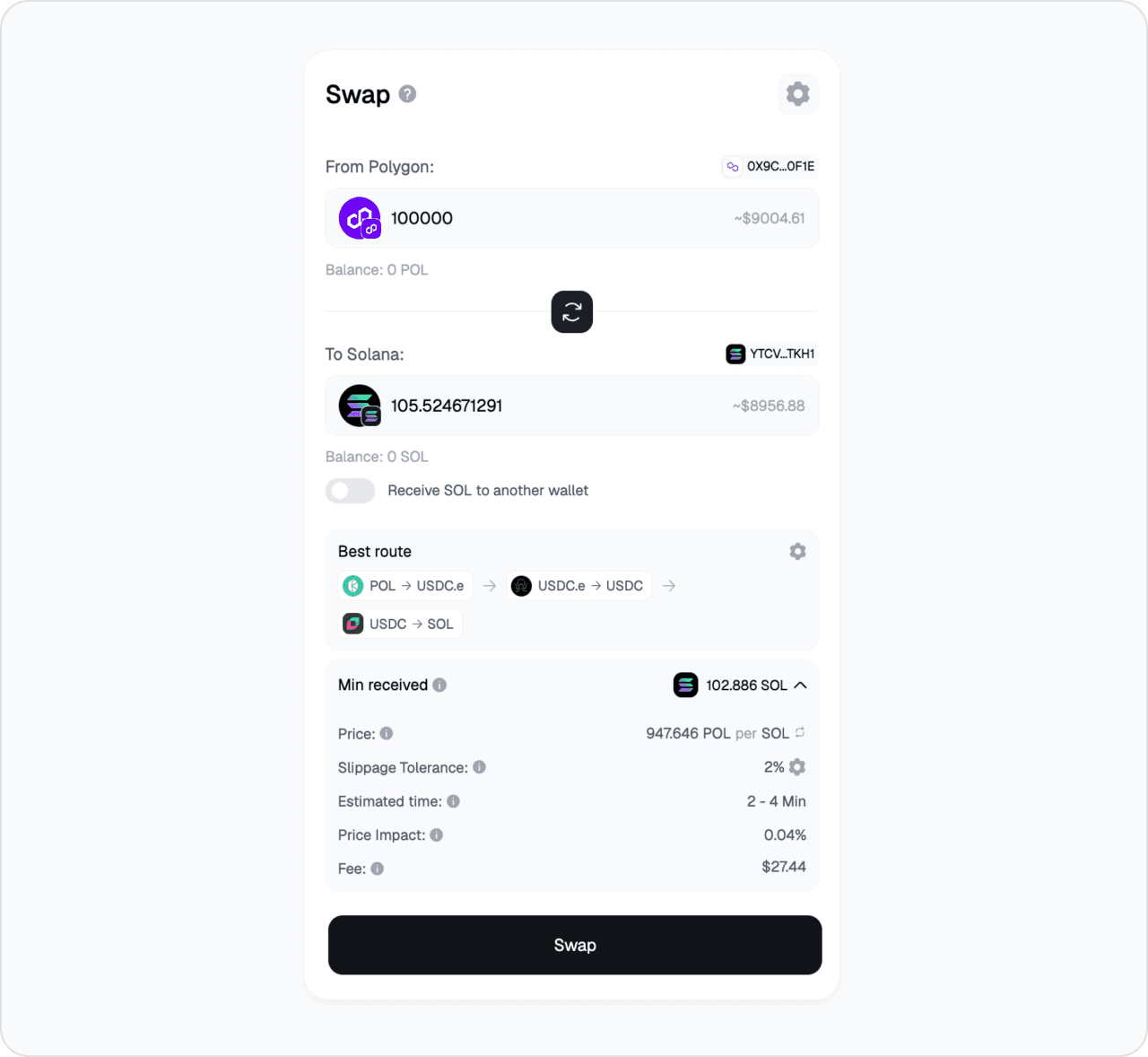
Total cost has three components: (1) Polygon gas: $0.01–$0.05 in POL to approve and send the transaction. (2) Symbiosis routing fee: Typically 0.3–0.4% of transaction value, covering liquidity provider incentives and cross-chain message relaying. For a $9,004 bridge (100,000 POL → 105.52 SOL), the fee was $27.44. (3) Solana rent-exempt activation (one-time): If the recipient Solana account is brand new, ~0.00089 SOL (~$0.075 at $84/SOL) is reserved to make the account rent-exempt; this is deducted from your first receipt only, never charged again. No hidden fees, no custody charges. Price impact depends on trade size and liquidity depth—0.04% for $9K in the May 20 example. All fees are disclosed upfront in the Symbiosis UI before you sign.

Total cost has three components: (1) Polygon gas: $0.01–$0.05 in POL to approve and send the transaction. (2) Symbiosis routing fee: Typically 0.3–0.4% of transaction value, covering liquidity provider incentives and cross-chain message relaying. For a $9,004 bridge (100,000 POL → 105.52 SOL), the fee was $27.44. (3) Solana rent-exempt activation (one-time): If the recipient Solana account is brand new, ~0.00089 SOL (~$0.075 at $84/SOL) is reserved to make the account rent-exempt; this is deducted from your first receipt only, never charged again. No hidden fees, no custody charges. Price impact depends on trade size and liquidity depth—0.04% for $9K in the May 20 example. All fees are disclosed upfront in the Symbiosis UI before you sign.

03

How long does it take to bridge from Polygon to Solana?

Symbiosis estimates ~26 sec in the UI. Speed depends on Polygon block confirmation (2-second finality), cross-chain message relay, and Solana transaction settlement (sub-second). The route's three-hop architecture (POL→USDC.e on Polygon, USDC.e→USDC cross-chain, USDC→SOL on Solana) is parallelized under the hood, so users see near-instant progress updates. Zero transactions have exceeded 8 minutes in the reporting period.


Symbiosis estimates ~26 sec in the UI. Speed depends on Polygon block confirmation (2-second finality), cross-chain message relay, and Solana transaction settlement (sub-second). The route's three-hop architecture (POL→USDC.e on Polygon, USDC.e→USDC cross-chain, USDC→SOL on Solana) is parallelized under the hood, so users see near-instant progress updates. Zero transactions have exceeded 8 minutes in the reporting period.


04

Can I bridge USDC from Polygon to Solana, or only POL?

In fact, 100% of the route's 90-day volume ($394K) was USDC.e → SOL bridges, not POL → SOL. The UI auto-detects your Polygon wallet's token balances; you can select USDC.e, POL, or any supported Polygon asset. The three-hop route converts USDC.e → cross-chain USDC → native SOL on Solana. If you want USDC on Solana (instead of SOL), select USDC as the output token—Symbiosis will skip the final USDC→SOL swap and deliver USDC directly. Note: Polygon now uses POL (not MATIC) as the native gas token, so ensure you hold a small POL balance (~$0.05) to pay transaction fees regardless of which token you're bridging.


In fact, 100% of the route's 90-day volume ($394K) was USDC.e → SOL bridges, not POL → SOL. The UI auto-detects your Polygon wallet's token balances; you can select USDC.e, POL, or any supported Polygon asset. The three-hop route converts USDC.e → cross-chain USDC → native SOL on Solana. If you want USDC on Solana (instead of SOL), select USDC as the output token—Symbiosis will skip the final USDC→SOL swap and deliver USDC directly. Note: Polygon now uses POL (not MATIC) as the native gas token, so ensure you hold a small POL balance (~$0.05) to pay transaction fees regardless of which token you're bridging.


05

Which wallets work for bridging Polygon to Solana?

Polygon side (EVM): MetaMask, Trust Wallet, Rabby, or any wallet supporting Polygon PoS with 0x address format. You'll approve and sign the bridge transaction with this wallet. Solana side: Phantom, Solflare, Backpack, or Trust Wallet (Solana mode). Symbiosis lets you connect your Solana wallet in the UI, or manually paste a Solana address (base58 format, e.g., your Solana base58 address) if you want to send to a different recipient. The app does not require a single wallet to support both chains—your MetaMask (Polygon) and Phantom (Solana) work together seamlessly. If your Solana address is new, Symbiosis auto-reserves ~0.00089 SOL (~$0.075) for rent-exempt activation on first receipt, ensuring your account can hold the funds.

Polygon side (EVM): MetaMask, Trust Wallet, Rabby, or any wallet supporting Polygon PoS with 0x address format. You'll approve and sign the bridge transaction with this wallet. Solana side: Phantom, Solflare, Backpack, or Trust Wallet (Solana mode). Symbiosis lets you connect your Solana wallet in the UI, or manually paste a Solana address (base58 format, e.g., your Solana base58 address) if you want to send to a different recipient. The app does not require a single wallet to support both chains—your MetaMask (Polygon) and Phantom (Solana) work together seamlessly. If your Solana address is new, Symbiosis auto-reserves ~0.00089 SOL (~$0.075) for rent-exempt activation on first receipt, ensuring your account can hold the funds.

06

Has Symbiosis ever lost funds bridging Polygon to Solana?

No. Over 90 days (Feb 20–May 21, 2026), the Polygon → Solana route achieved a 100% success rate: 46 transactions, zero failed, zero reverted, $394,466 total volume delivered. Year-to-date 2026: 100 transactions, 100% success. Symbiosis is a non-custodial protocol—you retain control of private keys at all times; the contracts lock your source tokens and release destination tokens atomically via cross-chain messaging. If a cross-chain message fails (e.g., destination chain congestion), Symbiosis's routing layer includes fallback liquidity paths and auto-refund mechanisms to return funds to your source wallet. The protocol has processed billions in cumulative volume across all routes since 2021 without a loss-of-funds incident. All smart contracts are audited (publicly available reports on symbiosis.finance/security), and the routing layer is monitored 24/7 for anomalies.

No. Over 90 days (Feb 20–May 21, 2026), the Polygon → Solana route achieved a 100% success rate: 46 transactions, zero failed, zero reverted, $394,466 total volume delivered. Year-to-date 2026: 100 transactions, 100% success. Symbiosis is a non-custodial protocol—you retain control of private keys at all times; the contracts lock your source tokens and release destination tokens atomically via cross-chain messaging. If a cross-chain message fails (e.g., destination chain congestion), Symbiosis's routing layer includes fallback liquidity paths and auto-refund mechanisms to return funds to your source wallet. The protocol has processed billions in cumulative volume across all routes since 2021 without a loss-of-funds incident. All smart contracts are audited (publicly available reports on symbiosis.finance/security), and the routing layer is monitored 24/7 for anomalies.

07

Why does Symbiosis use a three-hop route (POL → USDC.e → USDC → SOL)?

Direct POL → SOL liquidity doesn't exist on-chain because Polygon (EVM) and Solana (SVM) are incompatible virtual machines with no shared liquidity pools. Symbiosis solves this by acting as a liquidity meta-aggregator: (1) On Polygon, it swaps POL → USDC.e via Polygon DEXs (e.g., Uniswap, QuickSwap). (2) It bridges USDC.e cross-chain using Symbiosis's own liquidity pools and relayer network, converting to canonical USDC. (3) On Solana, it swaps USDC → native SOL via Solana DEXs (e.g., Jupiter, Orca). This three-hop architecture is abstracted in the UI—you see a single transaction—but under the hood, Symbiosis routes through the most liquid stablecoin pairs to minimize slippage (0.04% in the May 20 example) and maximize speed. The result: you send POL from an EVM wallet and receive native SOL (not wrapped, not synthetic) in your Solana wallet, ready to use immediately in Solana DeFi, staking, or NFT marketplaces.

Direct POL → SOL liquidity doesn't exist on-chain because Polygon (EVM) and Solana (SVM) are incompatible virtual machines with no shared liquidity pools. Symbiosis solves this by acting as a liquidity meta-aggregator: (1) On Polygon, it swaps POL → USDC.e via Polygon DEXs (e.g., Uniswap, QuickSwap). (2) It bridges USDC.e cross-chain using Symbiosis's own liquidity pools and relayer network, converting to canonical USDC. (3) On Solana, it swaps USDC → native SOL via Solana DEXs (e.g., Jupiter, Orca). This three-hop architecture is abstracted in the UI—you see a single transaction—but under the hood, Symbiosis routes through the most liquid stablecoin pairs to minimize slippage (0.04% in the May 20 example) and maximize speed. The result: you send POL from an EVM wallet and receive native SOL (not wrapped, not synthetic) in your Solana wallet, ready to use immediately in Solana DeFi, staking, or NFT marketplaces.

08

How does Symbiosis compare to using a CEX (Binance, Coinbase) for Polygon → Solana?

Symbiosis (non-custodial bridge): No KYC, no account, no withdrawal limits. You keep private keys; bridge completes in ~26 sec; 0.3–0.4% routing fee + $0.01 Polygon gas. Delivers native SOL directly to your Solana wallet. CEX route: Requires KYC, deposits POL or USDC.e to exchange, swaps to SOL, withdraws via Solana network. Pros: simple UX, no smart-contract risk. Cons: custody risk (exchange holds funds during deposit/withdrawal), withdrawal fees (often $1–$5 flat + network fee), potential withdrawal delays (manual approval, AML checks), and regulatory exposure (account freezes, tax reporting). For amounts under $10K, Symbiosis is faster and cheaper; for $50K+, CEX fees may be lower but custody risk increases.

Symbiosis (non-custodial bridge): No KYC, no account, no withdrawal limits. You keep private keys; bridge completes in ~26 sec; 0.3–0.4% routing fee + $0.01 Polygon gas. Delivers native SOL directly to your Solana wallet. CEX route: Requires KYC, deposits POL or USDC.e to exchange, swaps to SOL, withdraws via Solana network. Pros: simple UX, no smart-contract risk. Cons: custody risk (exchange holds funds during deposit/withdrawal), withdrawal fees (often $1–$5 flat + network fee), potential withdrawal delays (manual approval, AML checks), and regulatory exposure (account freezes, tax reporting). For amounts under $10K, Symbiosis is faster and cheaper; for $50K+, CEX fees may be lower but custody risk increases.

Two chains. One click

Bridge POL or USDC.e to native SOL on Solana — ~26s, 100% success rate, no wrapped tokens.

Bridge Solana banner