13 minute reading
What is a crypto mixer?
A crypto mixer, also called a tumbler, is a service that collects coins from many users, pools them and pays each user back from different addresses, usually after a delay and sometimes in several smaller amounts. On Bitcoin or Ethereum anyone can follow coins from address to address; a mixer is built to break that trail, so the payout cannot be matched to the deposit just by reading the chain.
Mixers come in three designs:
Custodial mixers. You send coins to an operator and receive other coins back. You have to trust the operator with both the coins and the records. Helix, Bitcoin Fog, ChipMixer and Cryptomixer worked this way, and all four ended in prosecutions or seizures.
Smart-contract mixers. Code on a blockchain holds the pool instead of a company. On Tornado Cash, the best-known example, a user deposits a fixed amount and later withdraws it to a new address with a cryptographic proof that a deposit was made, without revealing which one.
CoinJoin. Several Bitcoin users combine their payments into one transaction with many equal outputs, so an observer cannot tell whose input paid which output. A coordinator assembles the transaction but never holds the coins; Samourai Wallet and the Wasabi wallet company ran such coordinators until 2024.
A mixer only removes the visible link between deposit and payout. The coins going in and the coins coming out both stay public, and whoever runs the service can see both sides. When German and Swiss police seized Cryptomixer in November 2025, they took its servers and more than 12 terabytes of data (eucrim).
Is it legal to use a crypto mixer?
Using a crypto mixer is not illegal by itself in the United States or the European Union: no federal US law or EU regulation makes it a crime to send your own, legally obtained coins through one. What is illegal is mixing proceeds of crime, which is money laundering, dealing with a sanctioned mixer, and running a mixing business without a money transmitter licence. Rules differ by country, and this article is not legal advice.
United States
No mixing rule. In October 2023 FinCEN proposed treating international crypto mixing as a “class of transactions of primary money laundering concern”, which would have required banks and exchanges to report it (FinCEN). On 5 October 2026 it announced the withdrawal of the proposal (FinCEN), citing concerns that its broad definition could have “a chilling effect on legitimate activity”, and said it would keep monitoring mixers (Federal Register).
Treasury’s view. In a March 2026 report to Congress, Treasury wrote that “lawful users of digital assets may leverage mixers to enable financial privacy when transacting through public blockchains”, for example to keep personal wealth, business payments or charitable donations off a public ledger. The same report says “mixing is frequently used by DPRK cyber actors, money launderers, ransomware actors, participants in darknet markets, and other illicit actors” (Treasury).
Enforcement policy. An April 2025 Justice Department memo says the department “will no longer target virtual currency exchanges, mixing and tumbling services, and offline wallets for the acts of their end users or unwitting violations of regulations”, except where a case fits its priorities, such as fraud, terrorism or drug trafficking (DOJ).
Sanctions. US persons may not deal with a mixer on the Treasury sanctions list. Treasury sanctioned Blender.io in May 2022 and Sinbad.io in November 2023, both over laundering for North Korea’s Lazarus Group (Treasury). Tornado Cash was on the list from August 2022 until 21 March 2025 (Treasury); in November 2024 an appeals court had ruled that its immutable smart contracts are not “property” that can be sanctioned (Fifth Circuit).
Operators. The founders of Samourai Wallet were sentenced in November 2025 to five and four years in prison after admitting a conspiracy to operate an unlicensed money transmitting business (DOJ). Tornado Cash co-founder Roman Storm was convicted of the same conspiracy in August 2025; his retrial on money laundering and sanctions charges is set for 26 April 2027 (The Block).
European Union
From 10 July 2027. The EU anti-money-laundering regulation bars banks and crypto-asset service providers from keeping anonymous accounts or accounts that allow anonymisation or increased obfuscation of transactions, including through anonymity-enhancing coins (EUR-Lex). It regulates those providers, not people using software on their own.
Netherlands. A Dutch court convicted Tornado Cash developer Alexey Pertsev of money laundering in May 2024 and sentenced him to 64 months in prison; he has appealed (DL News).
Germany and Switzerland. Prosecutors in Frankfurt and Zurich seized Cryptomixer in November 2025 with support from Europol and Eurojust (eucrim).

What sanctions did to Tornado Cash: our count
Tornado Cash’s history is public, because its pools are smart contracts on Ethereum. We counted every deposit into its four ETH pools, of 0.1, 1, 10 and 100 ETH, from January 2021 to September 2026.
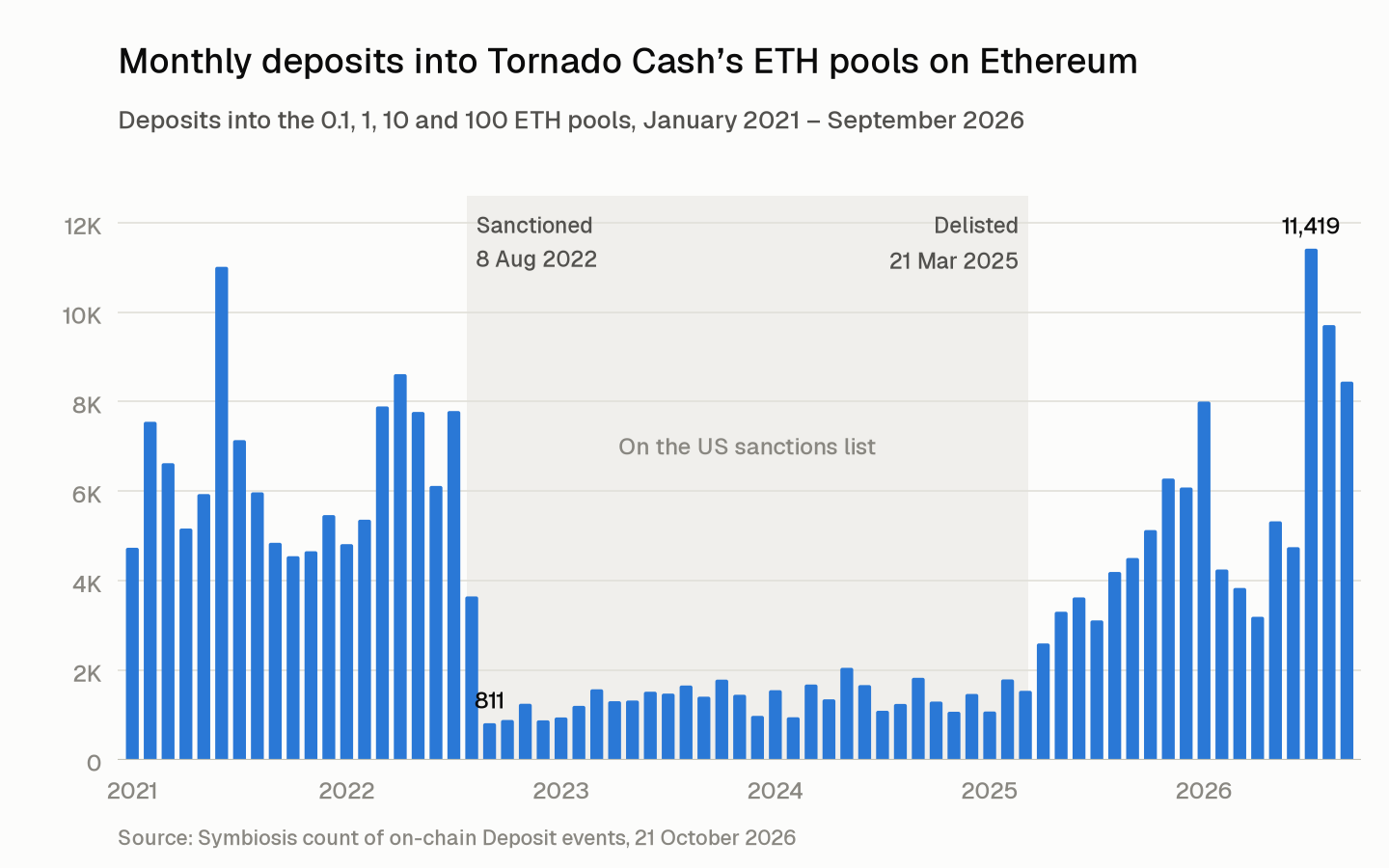
The sanctions of 8 August 2022 cut deposits by 80% but did not stop them: the contracts kept running, and through the 30 full months on the list the pools still took about 1,350 deposits a month. After the delisting on 21 March 2025, deposits tripled, and July 2026 brought 11,419, the most of any month since January 2021.
Period | Deposits per month | ETH per month | Change |
Aug 2021 – Jul 2022, before the sanctions | 6,153 | 142,937 | — |
Sep 2022 – Aug 2023, after the sanctions | 1,232 | 25,269 | −80% deposits, −82% ETH |
Mar 2024 – Feb 2025, before the delisting | 1,465 | 40,879 | — |
Apr 2025 – Mar 2026, after the delisting | 4,575 | 67,296 | ×3.1 deposits, +65% ETH |
Jan – Sep 2026 | 6,546 | 63,226 | +6% deposits, −56% ETH against the year before the sanctions |
Deposits in 2026 are back to the level of the year before the sanctions, but with less than half the ETH, because they got smaller: the 0.1 ETH pool took 43% of deposits in January–September 2026, against 13% in the year before the sanctions.
How we counted: each pool numbers its deposits in order, so the number carried by the first deposit after each month boundary, read from the pools’ Deposit events through the Etherscan API, gives the monthly count; direct counts of three pool-months matched it exactly. The count covers the four ETH pools on Ethereum, not the token pools or other networks, and a deposit is not a person: one user can make many.
What happened to the best-known mixers
Every entry below comes from a government release, a court document or reporting on court records, as of 21 October 2026. Figures are the authorities’ allegations or findings.
When | Service | What happened |
Aug 2021 – Jan 2026 | Helix | Operator pleaded guilty to money laundering conspiracy, got 36 months in 2024; the US took title to over $400M in assets. Helix processed about 354,468 BTC in 2014–2017 |
Mar – Nov 2024 | Bitcoin Fog | Operator convicted of money laundering and sentenced to more than 12 years; forfeiture judgment of $395.6M |
May 2022 | Blender.io | First mixer put on the US sanctions list, over Lazarus Group laundering |
Aug 2022 – Mar 2025 | Tornado Cash | Sanctioned after Treasury said it had laundered over $7B since 2019; delisted in March 2025, four months after the Fifth Circuit ruling |
Mar 2023 | ChipMixer | US and German takedown; servers and $46M in crypto seized; DOJ says it laundered over $3B since 2017 |
Nov 2023 | Sinbad.io | Sanctioned by Treasury over Lazarus Group laundering |
May 2024 | Tornado Cash developer | Alexey Pertsev sentenced to 64 months in the Netherlands; appeal filed |
Jun 2024 | Wasabi coordinator | zkSNACKs, the company behind Wasabi, shut its CoinJoin coordinator on 1 June, weeks after the Samourai arrests |
Apr 2024 – Nov 2025 | Samourai Wallet | Founders arrested, then sentenced to five and four years; DOJ says over $237M in criminal proceeds passed through it |
Aug 2025 | Tornado Cash co-founder | Roman Storm convicted of an unlicensed money transmitting conspiracy; retrial on two counts set for April 2027 |
Nov 2025 | Cryptomixer | Seized in Germany and Switzerland with €25M in bitcoin; €1.3B mixed since 2016, according to the authorities |
Oct 2026 | FinCEN mixing rule | Proposal to treat mixing as a primary money laundering concern withdrawn |
Sources: DOJ on Helix, DOJ on Bitcoin Fog, Treasury on Tornado Cash, DOJ on ChipMixer, Treasury on Sinbad and Blender, zkSNACKs announcement, DOJ on Samourai, The Block on Roman Storm, eucrim on Cryptomixer. Custodial operators were prosecuted or shut down; the cases still open concern developers of non-custodial code.
Can mixed crypto be traced?
Often, yes. A mixer hides the link on the chain, but investigators also work with timing, amounts, exchange records and the mixers’ own servers.
Bitfinex. Ilya Lichtenstein stole about 120,000 bitcoin from Bitfinex in 2016 and laundered part of it through cryptocurrency mixers and non-compliant exchanges; he was arrested in 2022 and sentenced to five years in November 2024 (DOJ).
Seized servers. When a custodial mixer is taken down, its logs go with it: ChipMixer’s back-end servers were seized in Germany in 2023, Cryptomixer’s in Switzerland in 2025.
Exchange screening. Exchanges screen incoming funds with blockchain analytics. Compliance firm Elliptic advises that the use of mixers “should be a factor in assessing the risks” of a transaction and “may justify further investigation into the source of funds”, while noting there are “perfectly innocent reasons to use a mixer” (Elliptic).
Will an exchange accept coins from a mixer?
That is up to each exchange, so we read the user agreements of six large exchanges in full on 21 October 2026, looking for mixers, tumblers, CoinJoin and anonymisation.
Exchange | Mixers in the terms | What the exchange may do |
Gemini | Banned by name | Suspend the account, freeze funds, ask for the source of funds |
Coinbase | Not mentioned | Refuse, cancel or reverse transactions suspected of money laundering |
Kraken | Not mentioned | Ask for proof of the source of funds, suspend the account, freeze balances |
OKX | Not mentioned | Block transactions or freeze funds linked to proceeds of unlawful activities |
KuCoin | Not mentioned | Suspend or terminate services if a transaction is suspicious or laundering is suspected |
Bitget | Not mentioned | Block transactions and restrict withdrawals over suspected money laundering |
Only Gemini names mixers, defining a mixing service as “a mixer or tumbler used to obscure the source of funds”. The other five do not mention mixers, but each can block transactions or suspend accounts over suspected money laundering, and mixer history is one of the things blockchain screening flags. So a deposit with mixer history can be held until you explain where the coins came from.
Sources: Gemini user agreement, Coinbase US user agreement and Prohibited Use Policy, Kraken EEA terms of service, OKX terms of service, KuCoin terms of use, Bitget terms of use.
Risks of using a mixer
Your coins can disappear. With a custodial mixer you hand coins to an operator with no recourse; when ChipMixer and Cryptomixer were seized, $46M and €25M in crypto were seized with them.
Your deposit can be held. An exchange that sees mixer history may ask where the funds came from before it credits them.
Sanctions cover the service itself. For US persons, sending coins to a sanctioned mixer is a violation even with clean funds.
Records do not vanish. Operators’ logs end up with investigators when a service is seized.

An alternative to mixers: private swaps on Symbiosis
The privacy Treasury describes, keeping your wealth, business payments or donations off a public ledger, does not require a mixer. Symbiosis offers private swaps: you swap crypto you already hold, from your own wallet and with no account, through a private route.
A private swap differs from a mixer in three ways:
One swap instead of a shared pool. A mixer pays you back from coins pooled with other users, often after a deliberate delay; a private swap converts your own crypto along one route, in about 30 minutes between networks, or about 6 minutes from USDT on Tron into Monero.
A refund path. If a private transfer is rejected during execution, the tokens are returned to the sender’s address, according to the Symbiosis documentation. When ChipMixer and Cryptomixer were seized, the coins inside were seized with them.
A history you can explain. Your deposit stays on its public chain and you keep the transaction hashes, so if an exchange asks where funds came from, you can show it.
Private Swap & Send: USDT between networks
Private Swap & Send moves tokens between networks through a private route. For 1,000 USDT from Tron to Ethereum on 16 October 2026, it quoted ≈991.33 USDT back, about 0.9% less than sent, with a $1.03 gas line and about 30 minutes; the route card read Send from Tron → Private → Receive on Ethereum.
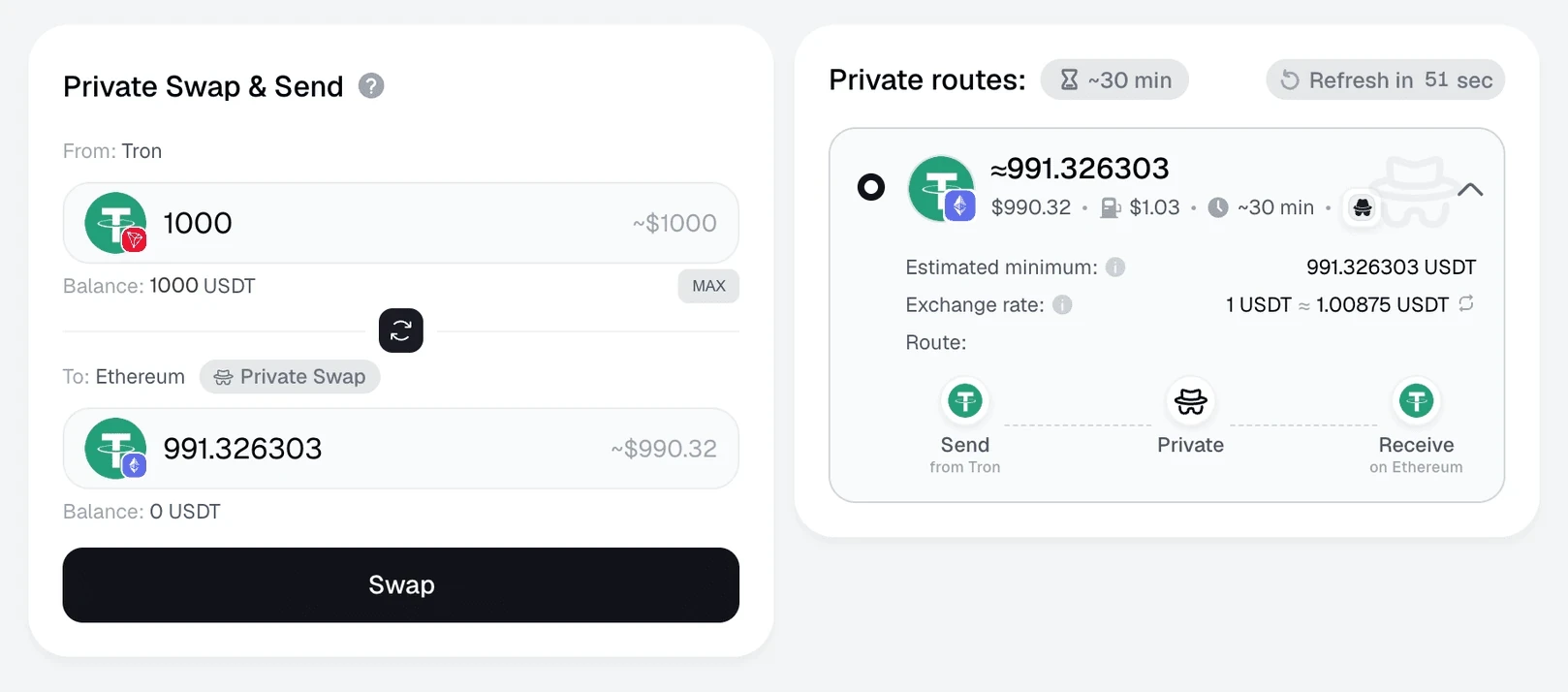
According to the Symbiosis documentation, a Private step means the route is not executed through standard Symbiosis bridge and swap operations; private routes may use privacy-oriented assets, centralized providers or semi-centralized providers, and may take longer than regular swaps. In the documentation’s words, this “provides an additional layer of route privacy, but it does not make the swap fully anonymous”.
Swap into Monero: privacy that continues after the swap
Monero hides the sender, the receiver and the amount of every transaction by default (getmonero.org), so coins you swap into XMR stay private when you spend them later. Over the 90 days to 15 October 2026, 51 swaps of USDT on Tron into XMR on Symbiosis took 5 minutes 51 seconds at the median, measured from the deposit transaction to the payout.
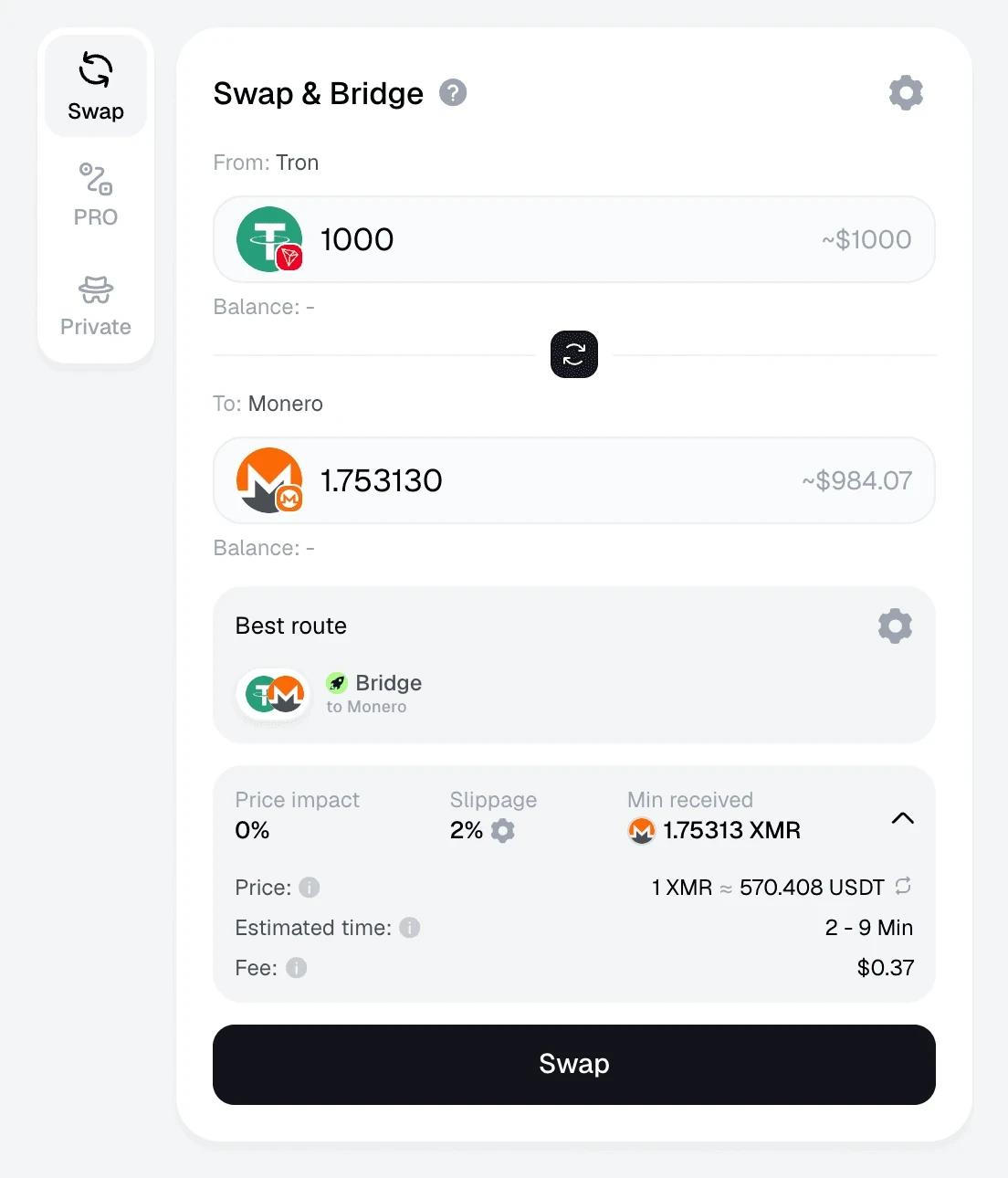
Owning and swapping Monero is legal in most countries, and Zcash offers the same privacy with shielded addresses. In the EU, regulated providers may not offer accounts that allow anonymisation through such coins from 10 July 2027.
What a private swap does not do
A private swap does not launder money as such and does not turn criminal proceeds into clean money: the crypto you send stays visible on its own chain, and the swap service keeps its own record of the swap. What it keeps private is the route between networks and, with Monero, what happens to the coins afterwards.
To compare routes into Monero, read where to buy Monero without KYC, follow the step-by-step USDT to Monero guide, or check live rates on the Monero (XMR) exchange page and the no-KYC crypto exchange overview.
How we collected the information
This article was prepared by Symbiosis. Legal facts were checked on 21 October 2026 against primary documents: the Justice Department’s April 2025 memo and release on Samourai Wallet, Treasury’s Tornado Cash delisting and March 2026 report to Congress, FinCEN’s withdrawal notice in the Federal Register, the EU anti-money-laundering regulation on EUR-Lex and the Fifth Circuit opinion. Where no primary text was available, we used court reporting by The Block and DL News. Tornado Cash deposits were counted from on-chain Deposit events, and the exchange terms were read in full on the same day. Symbiosis quotes were taken on 16 October 2026 without executing swaps, and delivery times are measured on-chain for completed swaps. This is general information, not legal advice.

Share this: