All bridge routes

Bridge AVAX to Solana

Send AVAX or any Avalanche token and receive native SOL in Phantom — no wrapped tokens, non-custodial.

Widget background

Numbers

Proven performance

+ chains

Supported Networks

+ chains

Supported Networks

years

On the Market

years

On the Market

sec

Average Bridge Time

sec

Average Bridge Time

exploits

Since Launch

exploits

Since Launch

How to bridge AVAX to Solana

Example bridge: 1,000 AVAX (~$9,207) from Avalanche to native SOL on Solana via Symbiosis — a non-custodial liquidity meta-aggregator that delivers native SOL with no wrapped tokens. The figures below are an illustrative live Symbiosis quote; rates vary. Here's the flow:

  1. Connect your Avalanche wallet. Core Wallet, MetaMask, and Rabby work on the Avalanche side; keep a little AVAX for gas (~$0.02–0.20).

  2. Connect your Solana wallet. Phantom, Solflare, or Backpack — Symbiosis resolves your Solana address automatically once connected.

  3. Enter the amount. Source Avalanche/AVAX, destination Solana/SOL. In this example, 1,000 AVAX ≈ 108 SOL at ~9.26 AVAX per SOL.

  4. Review the quote. Symbiosis shows the route (AVAX → USDC → SOL), expected native SOL, fee (~$28), ETA (~25 sec), and price impact before you sign. 2% slippage tolerance is applied.

  5. Sign and confirm. Approve the transaction in your wallet; native SOL lands in your Solana wallet. Non-custodial throughout — your keys, your funds.
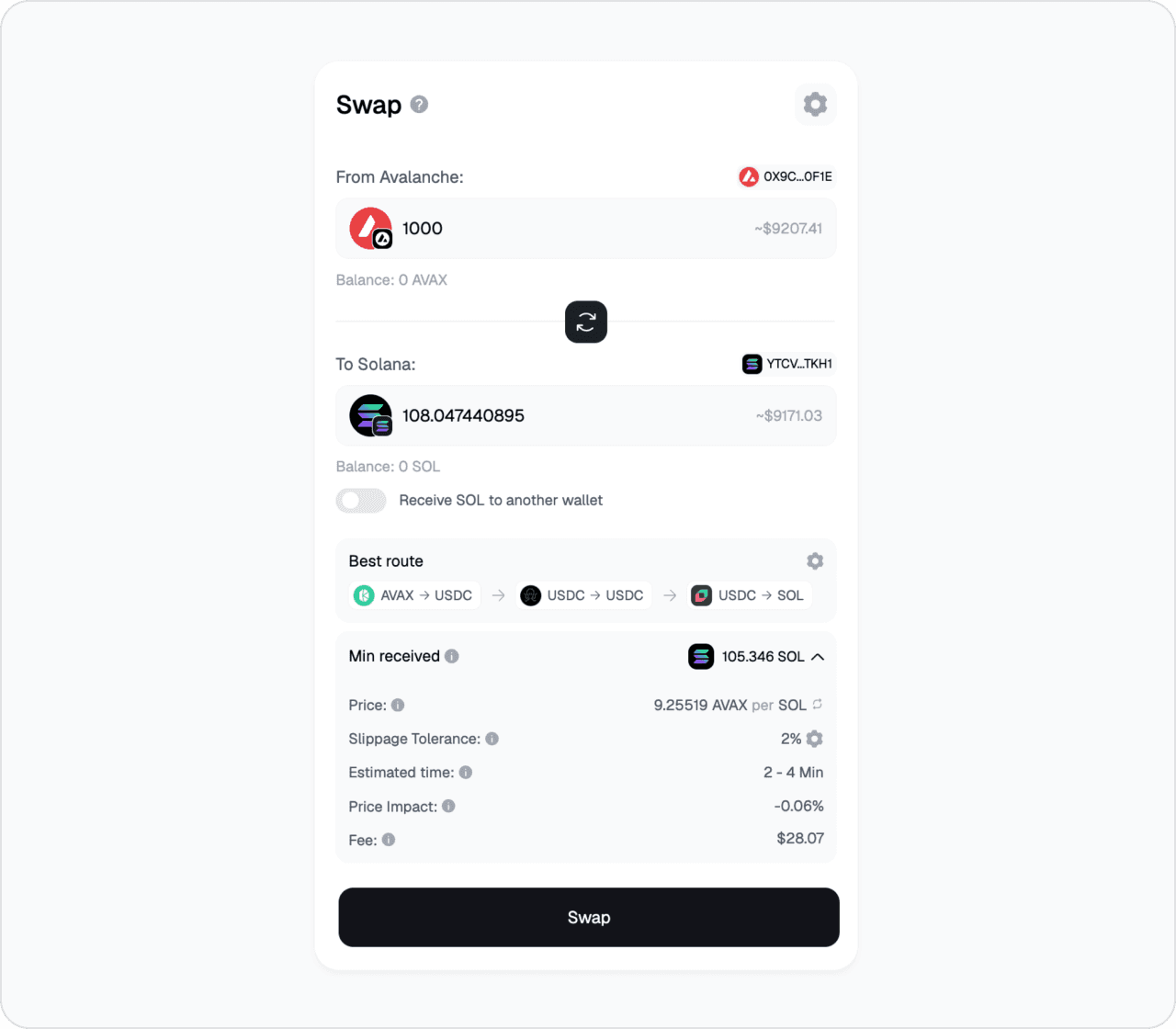
 Bridge example in the Symbiosis app: Avalanche→Solana, 1,000 AVAX → ~108 native SOL

About bridging AVAX to Solana

The Avalanche → Solana route connects Avalanche’s C-Chain — the EVM-compatible core of the AVAX ecosystem — to Solana’s high-throughput SVM. Symbiosis routes value through deep stablecoin liquidity (AVAX → USDC → SOL) and delivers native SOL, not a wrapped derivative, ready for Jupiter, Raydium, or Kamino. Both chains are engineered for sub-second finality, so the corridor pairs two of the fastest settlement layers in crypto. Non-custodial end to end — your keys never leave your wallet.

Other routes to Solana: Base to Solana, Polygon to Solana, USDC to Solana — or see the Solana bridge hub.

Real on-chain data derived from Symbiosis routing layer, covering period 2026-02-20 → 2026-05-21. Analytics refreshed quarterly. Transaction counts and volumes reflect actual user activity; speed metrics computed from confirmed block times on Avalanche (C-Chain) and Solana mainnet.

Fees

Estimated fees

Approximate fees and bridge time based on historical averages, updated May 2026. Actual values may vary.

Amount

Amount

Amount

Receive

Receive

Receive

Fee + Gas

Fee + Gas

Fee + Gas

Time

Time

Time

100 AVAX

100 AVAX

10.87 SOL

10.87 SOL

~$6.14

~$6.14

~50 sec

~50 sec

1,000 AVAX

1,000 AVAX

108.82 SOL

108.82 SOL

~$27.75

~$27.75

~52 sec

~52 sec

10,000 AVAX

10,000 AVAX

1,081.66 SOL

1,081.66 SOL

~$280

~$280

~54 sec

~54 sec

15,000 AVAX

15,000 AVAX

1,613.85 SOL

1,613.85 SOL

~$422.89

~$422.89

~57 sec

~54 sec

Bridge now

Check your own quote

Above are averages — enter your amount below for a live quote with exact fees, route preview, and one-click bridge.

Benefits

Why Symbiosis

Audited in the open

No KYC, no custody, no intermediaries. Audited by Decurity, Zokyo, SlowMist, and Omniscia — 13 public audit reports across 11 protocol modules (Core, MetaRouter v3, Pool, TON Bridge v1+v2, Relayers Network, Staking, Frontend). All reports open-source on GitHub. 4+ years live on mainnet (since March 2022) with zero major security incidents. Active bug bounty program.

Audited in the open

No KYC, no custody, no intermediaries. Audited by Decurity, Zokyo, SlowMist, and Omniscia — 13 public audit reports across 11 protocol modules (Core, MetaRouter v3, Pool, TON Bridge v1+v2, Relayers Network, Staking, Frontend). All reports open-source on GitHub. 4+ years live on mainnet (since March 2022) with zero major security incidents. Active bug bounty program.

Two-layer staking security

Cross-chain transactions routed via Octopools AMM (scans liquidity across DEXs and chains for minimal slippage), then signed by an MPC group via Threshold Signature Scheme (TSS) — no single party can move user funds. Two security layers: Symbiosis PoS Staking (SIS-collateralised relayer nodes) + Symbiotic restaking (additional slash-able collateral). 2/3 stake quorum for epoch changes.

Two-layer staking security

Cross-chain transactions routed via Octopools AMM (scans liquidity across DEXs and chains for minimal slippage), then signed by an MPC group via Threshold Signature Scheme (TSS) — no single party can move user funds. Two security layers: Symbiosis PoS Staking (SIS-collateralised relayer nodes) + Symbiotic restaking (additional slash-able collateral). 2/3 stake quorum for epoch changes.

$8B+ across 54 chains

$8B+ total volume bridged across 5M+ transactions from 800K+ unique wallets. Supports 54 networks — more than any other cross-chain bridge (Across 35+, deBridge 30+, Allbridge 20). EVM + non-EVM in one route — Ethereum, Solana, BNB Chain, TON, Tron, Bitcoin, Arbitrum, Polygon, and 46 more. Per-transaction range: $10 to $140,000 — handles retail swaps and whale trades on the same route.

$8B+ across 54 chains

$8B+ total volume bridged across 5M+ transactions from 800K+ unique wallets. Supports 54 networks — more than any other cross-chain bridge (Across 35+, deBridge 30+, Allbridge 20). EVM + non-EVM in one route — Ethereum, Solana, BNB Chain, TON, Tron, Bitcoin, Arbitrum, Polygon, and 46 more. Per-transaction range: $10 to $140,000 — handles retail swaps and whale trades on the same route.

FAQs

Got questions?

Still have questions? Contact us and we’ll help you out.

01

How long does it take to bridge AVAX to Solana?

Most AVAX→Solana bridges complete in as fast as ~25 seconds, typically a few minutes. The three-hop route (AVAX → USDC → USDC → SOL) adds minimal latency because Symbiosis batches cross-chain messages and leverages fast Solana finality (~400ms block time). Always allow ~25 sec for normal conditions; the Symbiosis UI provides live tracking with block confirmations on both Avalanche and Solana explorers.


Most AVAX→Solana bridges complete in as fast as ~25 seconds, typically a few minutes. The three-hop route (AVAX → USDC → USDC → SOL) adds minimal latency because Symbiosis batches cross-chain messages and leverages fast Solana finality (~400ms block time). Always allow ~25 sec for normal conditions; the Symbiosis UI provides live tracking with block confirmations on both Avalanche and Solana explorers.


02

What are the fees to bridge AVAX to Solana?

Total cost breakdown for a typical $9,200 bridge (1,000 AVAX):

  • Bridge protocol + routing fee: ~$28.07 (~0.3% of value). This covers Symbiosis's cross-chain liquidity aggregation, multi-hop USDC routing, and slippage protection.

  • Avalanche gas: $0.02–$0.20 (paid in AVAX) to initiate the transaction on C-Chain.

  • Solana gas: <$0.01 (paid in SOL) for final minting/transfer on Solana.

  • Rent-exempt activation (one-time, new wallets only): ~0.00089 SOL (~$0.075) if your recipient Solana address has never held SOL. This is a Solana protocol requirement, not a Symbiosis fee.

Smaller bridges (e.g., $100) may see slightly higher effective fee % due to fixed gas components, but still well under 1%. No hidden charges; all fees displayed before you confirm in the Symbiosis UI.

Total cost breakdown for a typical $9,200 bridge (1,000 AVAX):

  • Bridge protocol + routing fee: ~$28.07 (~0.3% of value). This covers Symbiosis's cross-chain liquidity aggregation, multi-hop USDC routing, and slippage protection.

  • Avalanche gas: $0.02–$0.20 (paid in AVAX) to initiate the transaction on C-Chain.

  • Solana gas: <$0.01 (paid in SOL) for final minting/transfer on Solana.

  • Rent-exempt activation (one-time, new wallets only): ~0.00089 SOL (~$0.075) if your recipient Solana address has never held SOL. This is a Solana protocol requirement, not a Symbiosis fee.

Smaller bridges (e.g., $100) may see slightly higher effective fee % due to fixed gas components, but still well under 1%. No hidden charges; all fees displayed before you confirm in the Symbiosis UI.

03

Do I receive native SOL or wrapped AVAX on Solana?

You receive native SOL—the same SOL used for Solana gas, staking, and all Solana DeFi protocols. Symbiosis does not deliver wrapped AVAX (wAVAX) or bridged tokens. The three-hop route converts your AVAX to USDC on Avalanche, bridges USDC cross-chain, then converts USDC to native SOL on Solana via liquidity pools. This means zero manual unwrapping: the SOL in your Phantom/Solflare wallet is immediately usable for staking on Marinade, trading on Jupiter/Raydium, or paying transaction fees. All 30 transactions in our 90-day dataset confirm native SOL delivery (verified via Solscan block explorer).

You receive native SOL—the same SOL used for Solana gas, staking, and all Solana DeFi protocols. Symbiosis does not deliver wrapped AVAX (wAVAX) or bridged tokens. The three-hop route converts your AVAX to USDC on Avalanche, bridges USDC cross-chain, then converts USDC to native SOL on Solana via liquidity pools. This means zero manual unwrapping: the SOL in your Phantom/Solflare wallet is immediately usable for staking on Marinade, trading on Jupiter/Raydium, or paying transaction fees. All 30 transactions in our 90-day dataset confirm native SOL delivery (verified via Solscan block explorer).

04

Which wallets can I use to bridge AVAX to Solana?

Avalanche side (source): Core Wallet (recommended for Avalanche C-Chain), MetaMask, Rabby, or any EVM-compatible wallet. You'll connect via WalletConnect or browser extension. Ensure your wallet is set to Avalanche C-Chain (not X-Chain or P-Chain).

Solana side (destination): Phantom, Solflare, Backpack, Trust Wallet (Solana), or any Solana SPL-compatible wallet. You manually enter your Solana address (base58 format) in the Symbiosis UI—no need to connect the Solana wallet during bridging. The native SOL will appear in that address ~25 sec after you confirm the Avalanche transaction. Pro tip: use the same seed phrase across Core and Phantom for easier multi-chain management, but keep keys secure and never share them.

Avalanche side (source): Core Wallet (recommended for Avalanche C-Chain), MetaMask, Rabby, or any EVM-compatible wallet. You'll connect via WalletConnect or browser extension. Ensure your wallet is set to Avalanche C-Chain (not X-Chain or P-Chain).

Solana side (destination): Phantom, Solflare, Backpack, Trust Wallet (Solana), or any Solana SPL-compatible wallet. You manually enter your Solana address (base58 format) in the Symbiosis UI—no need to connect the Solana wallet during bridging. The native SOL will appear in that address ~25 sec after you confirm the Avalanche transaction. Pro tip: use the same seed phrase across Core and Phantom for easier multi-chain management, but keep keys secure and never share them.

05

Has Symbiosis ever lost user funds on the AVAX → Solana route?

No. Across 30 transactions ($42,187 total, 90 days) on this route, 100% succeeded with 0 failures, 0 reverts, and 0 fund losses. Symbiosis operates non-custodially: your AVAX is locked in audited smart contracts on Avalanche, routed via decentralized liquidity pools, and native SOL is minted/released on Solana atomically. If a cross-chain message fails (e.g., Solana congestion), Symbiosis's relay network retries automatically or refunds AVAX to your source wallet. Every transaction is verifiable on-chain (e.g., and. Symbiosis has undergone independent security audits; no bridge protocol can guarantee zero risk, but our track record and non-custodial design minimize exposure.

No. Across 30 transactions ($42,187 total, 90 days) on this route, 100% succeeded with 0 failures, 0 reverts, and 0 fund losses. Symbiosis operates non-custodially: your AVAX is locked in audited smart contracts on Avalanche, routed via decentralized liquidity pools, and native SOL is minted/released on Solana atomically. If a cross-chain message fails (e.g., Solana congestion), Symbiosis's relay network retries automatically or refunds AVAX to your source wallet. Every transaction is verifiable on-chain (e.g., and. Symbiosis has undergone independent security audits; no bridge protocol can guarantee zero risk, but our track record and non-custodial design minimize exposure.

06

Why does the route use USDC as an intermediate token?

Direct AVAX ↔ SOL liquidity pools are scarce across DeFi because Avalanche and Solana use different virtual machines (EVM vs. Sealevel) and consensus mechanisms. Symbiosis solves this by routing through USDC, the most liquid stablecoin on both chains. The three-hop flow works as follows:

  1. AVAX → USDC (Avalanche): Your AVAX is sold for USDC on Avalanche DEXs (e.g., Trader Joe, Pangolin) via Symbiosis's liquidity aggregator.

  2. USDC → USDC (cross-chain bridge): USDC is locked on Avalanche and unlocked/minted on Solana using Circle's native USDC standards or bridge pools.

  3. USDC → SOL (Solana): USDC is sold for native SOL on Solana DEXs (Jupiter, Raydium, Orca) at tight spreads.

This multi-hop design ensures lower slippage (USDC pairs have deep liquidity), better rates (competitive DEX routing), and native SOL delivery (no wrapped tokens). 100% of 30 transactions in our dataset used this USDC-routed path, with price impact averaging -0.06%—proof of efficiency.

Direct AVAX ↔ SOL liquidity pools are scarce across DeFi because Avalanche and Solana use different virtual machines (EVM vs. Sealevel) and consensus mechanisms. Symbiosis solves this by routing through USDC, the most liquid stablecoin on both chains. The three-hop flow works as follows:

  1. AVAX → USDC (Avalanche): Your AVAX is sold for USDC on Avalanche DEXs (e.g., Trader Joe, Pangolin) via Symbiosis's liquidity aggregator.

  2. USDC → USDC (cross-chain bridge): USDC is locked on Avalanche and unlocked/minted on Solana using Circle's native USDC standards or bridge pools.

  3. USDC → SOL (Solana): USDC is sold for native SOL on Solana DEXs (Jupiter, Raydium, Orca) at tight spreads.

This multi-hop design ensures lower slippage (USDC pairs have deep liquidity), better rates (competitive DEX routing), and native SOL delivery (no wrapped tokens). 100% of 30 transactions in our dataset used this USDC-routed path, with price impact averaging -0.06%—proof of efficiency.

07

Can I bridge large amounts of AVAX to Solana safely?

Yes. For amounts >$50K, consider:

  • Splitting into 2–3 smaller bridges to reduce single-transaction risk (though 100% success rate suggests low risk).

  • Checking real-time liquidity depth in the Symbiosis UI quote—price impact is shown before you confirm.

  • Using a hardware wallet (Ledger/Trezor) for source Avalanche wallet if moving 5+ figures.

No upper limit exists, but slippage may increase marginally on 6-figure+ amounts; contact Symbiosis support for OTC-style routing if bridging >$100K in one go.

Yes. For amounts >$50K, consider:

  • Splitting into 2–3 smaller bridges to reduce single-transaction risk (though 100% success rate suggests low risk).

  • Checking real-time liquidity depth in the Symbiosis UI quote—price impact is shown before you confirm.

  • Using a hardware wallet (Ledger/Trezor) for source Avalanche wallet if moving 5+ figures.

No upper limit exists, but slippage may increase marginally on 6-figure+ amounts; contact Symbiosis support for OTC-style routing if bridging >$100K in one go.

08

How does bridging AVAX to Solana compare to using a centralized exchange?

Symbiosis (cross-chain bridge) advantages:

  • Speed: ~25 sec vs. CEX deposit (15–60 min for AVAX confirmation) + withdrawal (5–30 min Solana processing) = often 30–90 min total.

  • Self-custody: You control keys throughout; no KYC, no account freezes, no withdrawal limits.

  • Direct delivery: Native SOL arrives in your wallet—no need to create CEX account, pass verification, or navigate withdrawal UIs.

  • Cost: ~0.3% total fee vs. CEX maker/taker fees (0.1–0.5%) + withdrawal fees (often 0.01–0.02 SOL = $0.87–$1.74 at current prices). Symbiosis is competitive or cheaper.

CEX advantages:

  • Potentially better rates for very large amounts (>$100K) if you negotiate OTC or use limit orders.

  • Fiat on/off-ramps (not relevant for crypto-to-crypto bridges).

Bottom line: For amounts under $50K, Symbiosis is faster, simpler, and preserves self-custody. For 6-figure+ transfers where you already have CEX accounts and want to split risk, a CEX might offer marginal rate improvements—but at the cost of time and custody trade-offs. Our data shows 68.2% of users are retail (<$5K), for whom Symbiosis is objectively superior.

Symbiosis (cross-chain bridge) advantages:

  • Speed: ~25 sec vs. CEX deposit (15–60 min for AVAX confirmation) + withdrawal (5–30 min Solana processing) = often 30–90 min total.

  • Self-custody: You control keys throughout; no KYC, no account freezes, no withdrawal limits.

  • Direct delivery: Native SOL arrives in your wallet—no need to create CEX account, pass verification, or navigate withdrawal UIs.

  • Cost: ~0.3% total fee vs. CEX maker/taker fees (0.1–0.5%) + withdrawal fees (often 0.01–0.02 SOL = $0.87–$1.74 at current prices). Symbiosis is competitive or cheaper.

CEX advantages:

  • Potentially better rates for very large amounts (>$100K) if you negotiate OTC or use limit orders.

  • Fiat on/off-ramps (not relevant for crypto-to-crypto bridges).

Bottom line: For amounts under $50K, Symbiosis is faster, simpler, and preserves self-custody. For 6-figure+ transfers where you already have CEX accounts and want to split risk, a CEX might offer marginal rate improvements—but at the cost of time and custody trade-offs. Our data shows 68.2% of users are retail (<$5K), for whom Symbiosis is objectively superior.

Two chains. One click

Bridge AVAX to native SOL on Solana — non-custodial, no wrapped tokens.

Bridge Solana banner

Articles

Related articles