All bridge routes
Bridge ETH to Tron
Bridge ETH to Tron via Symbiosis. Native TRX output for cheap USDT-TRC20 transfers. Cross-VM EVM-to-TVM route, non-custodial, audited contracts.

Numbers
Proven performance
How to bridge ETH to Tron
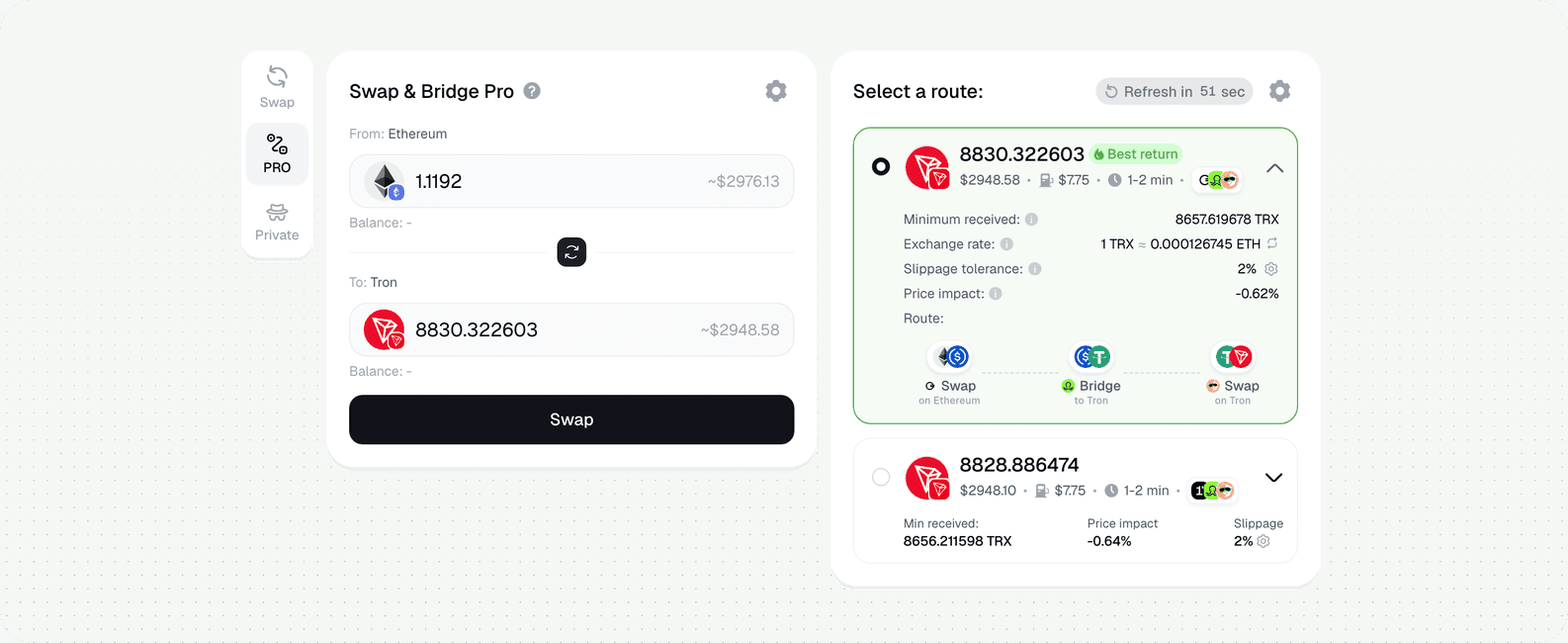
Bridging ETH to Tron is a cross-VM transfer — assets leave Ethereum's EVM and land on Tron's TVM as native TRX. The dominant use case is accessing USDT-TRC20, which leads global USDT transfer volume due to near-zero fees on Tron. Symbiosis handles the EVM-to-TVM execution with native TRX delivery.
Connect both wallets. MetaMask, Trust Wallet, or Rabby for Ethereum. TronLink, Trust Wallet, or Bitget Wallet for Tron. Both must be active so the route can resolve a valid Tron address.
Select source. Pick Ethereum and ETH as the source asset.
Select destination. Choose Tron and native TRX. The destination is auto-populated from your connected Tron wallet (Tron addresses start with T in base58 format).
Review the quote. Verify the TRX output, Symbiosis fee, and route time. TRX has a low unit price relative to ETH, so a small ETH amount converts to thousands of TRX.
Confirm and sign. Sign the Ethereum source transaction. Native TRX arrives at your Tron wallet, ready for USDT-TRC20 transfers, JustLend lending, or SunSwap.

About ETH to Tron route
ETH to Tron is a cross-VM bridge between EVM and TVM. The cohort here is mostly users moving value into the USDT-TRC20 ecosystem — Tron leads global USDT transfer volume due to fees that are typically fractions of a cent. After arrival, Tron transactions consume Energy and Bandwidth (Tron's gas model) instead of pure TRX, so first-time Tron users should budget a small TRX reserve for activity.
Tron addresses start with T (in base58 encoding, 34 characters), distinct from EVM 0x format. For a deeper comparison of ERC-20 vs TRC-20 stablecoin economics, see our ERC-20 vs TRC-20 bridge guide.
Other ETH routes
ETH → Solana — native SOL via EVM-to-SVM route
ETH → Bitcoin — native BTC delivery, no wrapped tokens
Estimated fees
Approximate fees and swap time based on historical averages, updated 3x/week. Actual values may vary.
Bridge now
Try to swap BNB to SOL
Transfer your ETH to BNB Chain in seconds with the best rates available.

Benefits
Why Symbiosis
FAQs
Got questions?
Still have questions? Contact us and we’ll help you out.
01
Why bridge ETH to Tron?
The dominant use case is USDT-TRC20 — Tron leads global USDT transfer volume because TRC-20 stablecoin transfers cost fractions of a cent versus dollars on Ethereum. Users bridging ETH to Tron usually convert to USDT-TRC20 next, then use it for cheap remittance, OTC settlement, or as the stablecoin layer in Asian crypto trading flows. Direct trading on Tron DeFi (JustLend, SunSwap) is secondary.
02
Will I receive native TRX or wrapped TRX?
Symbiosis delivers native TRX directly to your Tron address — not a wrapped representation. Native TRX is what you need to interact with Tron: pay Energy/Bandwidth for transactions, hold USDT-TRC20, stake into Tron Power, or use Tron DeFi. Wrapped TRX on EVM chains exists but isn't what you receive here.
03
What's the difference between Tron addresses and Ethereum addresses?
Ethereum addresses are 0x-prefixed hex (42 chars) used by EVM chains. Tron addresses start with T (in base58 encoding, 34 chars). They're entirely different formats — pasting an Ethereum address into a Tron wallet (or vice versa) means lost funds. Symbiosis prevents this by auto-resolving the Tron destination from your connected TronLink/Trust Wallet, so the address shown in the quote is guaranteed valid.
04
How long does ETH to Tron bridging take?
End-to-end typically 30–90 seconds: Ethereum source confirmation (12–60 seconds based on congestion) plus Tron finality (~3 seconds). Tron has fast block production (~3 second block time) and immediate finality after a few blocks, so the destination side settles quickly once routed.
05
Why does Tron use Energy and Bandwidth instead of just TRX for gas?
Tron has a dual-resource model. Bandwidth covers basic transactions (transfers, etc.) and is free up to a daily limit per account. Energy covers smart contract execution (USDT-TRC20 transfers, DeFi interactions) and is consumed per transaction. Both can be obtained by burning TRX or by staking TRX into Tron Power. For most users, holding 50–100 TRX is enough to cover Energy needs for active USDT-TRC20 use without manual staking. More on Tron's gas model in our guide.
06
How much does it cost to bridge ETH to Tron?
Costs include Symbiosis protocol fee (shown upfront in the quote) and Ethereum source gas. In 2026 conditions Ethereum gas for a bridge transaction runs $1–$15 typical (with congestion spikes possible). Tron destination delivery is included. After arrival, Tron-side fees for USDT-TRC20 transfers are pennies, which is the main reason to bridge here.
07
Can I bridge USDT directly from Ethereum to Tron without going through TRX?
Yes — Symbiosis supports USDT-ERC20 → USDT-TRC20 directly, which is often the cleaner flow for users whose end goal is stablecoin on Tron. Choose USDT as source token (on Ethereum) and USDT as destination token (on Tron). The bridge handles the cross-VM conversion. Small TRX is still recommended on the destination side to cover Energy for future TRC-20 transfers.
08
Is bridging ETH to Tron via Symbiosis safer than a centralized exchange route?</p>
A CEX route requires depositing ETH (custody risk + KYC), trading ETH for TRX or USDT, then withdrawing TRC-20 (more custody + withdrawal limits). Symbiosis is non-custodial: audited smart contracts execute the cross-VM route, you sign yourself, no identity verification. The trade-off is on-chain transaction risk versus CEX-specific risks like account freezes, especially relevant if your end use is moving stablecoin volume that some exchanges flag for AML review.
Articles
Related articles

Swap TRON in 2025: Best TRX Bridges and TRON swap platforms
Discover how to swap TRON (TRX) in 2025. Compare TRON bridges, learn how to bridge ETH to TRON, swap USDT to TRX, and use TRON DEXs.
Read article

TRON Gas-Free Explained: How USDT Pays Fees (No TRX Required)
Learn how TRON’s Gas-Free model lets TRC-20 USDT pay network fees in USDT – no TRX balance needed. See wallet support, costs, and pros and cons.
Read article

Best ETH Bridge in 2026: Fees, Speed, and Security Compared
Compare 9 ETH bridges by architecture, fees, speed, and exploit history. Intent-based vs liquidity pool vs lock-and-mint — which is safest in 2026.
Read article
Two chains. One click
Native TRX delivery — gateway to USDT-TRC20 cheapest stablecoin rail.