Bridge ETH to Solana
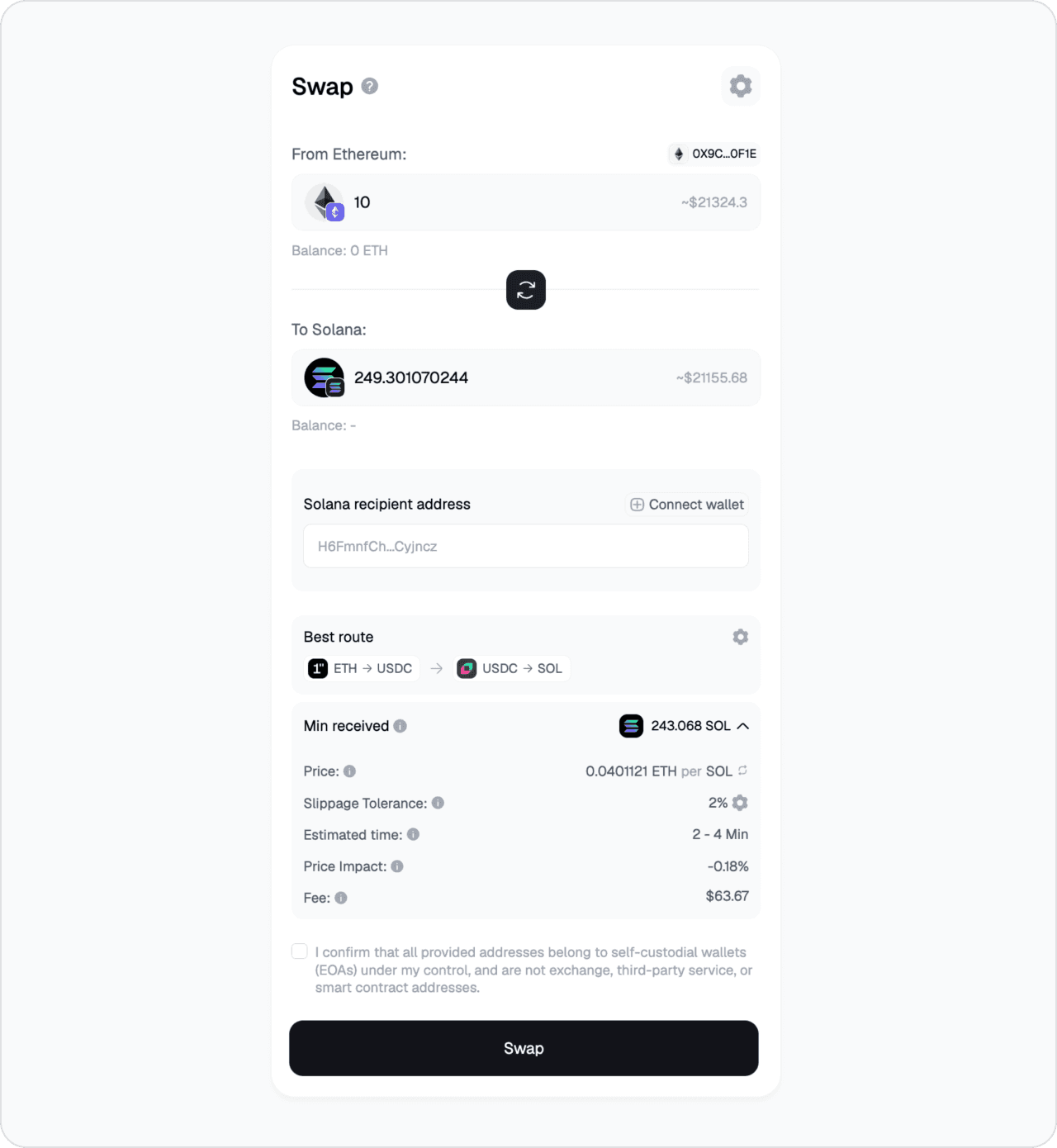
Bridge ETH to Solana via Symbiosis Octopools AMM. Receive native SOL (not wrapped), keep custody, no KYC. EVM→SVM route with Phantom support.

Numbers
Proven performance
How to Bridge ETH to Solana
Moving ETH from Ethereum to Solana means crossing from an EVM chain to a non-EVM chain (SVM). Symbiosis routes the swap through Octopools AMM and delivers native SOL — not wrapped — to your Solana wallet in one transaction.
Connect both wallets. Link MetaMask, Trust Wallet, or Rabby for Ethereum, plus Phantom, Solflare, or Backpack for Solana. Both must be active so the route can resolve a valid base58 destination.
Select source. Choose Ethereum as the source network and native ETH as the token to swap.
Select destination. Pick Solana and native SOL. The destination is auto-populated from your connected Solana wallet — no manual paste needed.
Review the quote. Verify the SOL output amount, route fees, and estimated time. Solana addresses use base58 (32–44 chars, no 0x), so the preview shows exactly where SOL will land.
Confirm and sign. Sign the Ethereum transaction. Native SOL arrives at your Phantom/Solflare wallet, ready for Jupiter, Raydium, Kamino, or Marinade — no unwrap step.

About ETH to Solana route
ETH to Solana is an EVM-to-SVM cross-chain transfer — assets leave Ethereum's EVM and land on Solana's SVM as native SOL. The cohort using this route holds ETH, wants Solana DeFi exposure (Jupiter swaps, Raydium pools, Marinade staking), and prefers not to wrap tokens or route through a centralized exchange.
After arrival, Solana transactions cost fractions of a cent in SOL, but accounts require a small SOL reserve for rent-exempt activation. For a deeper comparison of routes into Solana, see our guide on the top Solana bridge options.
Other ETH routes
ETH → Bitcoin — native BTC delivery, no wrapped tokens
ETH → Tron — native TRX, gateway to USDT-TRC20
Estimated fees
Approximate fees and swap time based on historical averages, updated 3x/week. Actual values may vary.
Bridge now
Try to swap BNB to SOL
Transfer your ETH to BNB Chain in seconds with the best rates available.

Benefits
Why Symbiosis
FAQs
Got questions?
Still have questions? Contact us and we’ll help you out.
01
How long does it take to bridge ETH to Solana?
A typical ETH→SOL bridge through Symbiosis settles in 30–90 seconds depending on Ethereum network congestion and Solana block confirmation. The Ethereum-side transaction takes the longest portion (12–60 seconds for confirmation), then the Solana side finalizes in under 5 seconds. You'll see a progress indicator with both transaction hashes during execution.
02
Can I send ETH directly to a Solana wallet?
No, you cannot paste ETH into a Solana wallet directly. Ethereum and Solana use entirely different address formats and consensus systems — Ethereum addresses are 0x-prefixed hex (42 chars) while Solana uses base58 (32–44 chars). Sending ETH to a Solana address would result in permanent loss. A bridge like Symbiosis handles the cross-VM conversion automatically, so the SOL you receive lands at a Solana-native address derived from your connected Phantom or Solflare wallet.
03
Will I receive native SOL or wrapped SOL?
Symbiosis delivers native SOL — the actual Solana asset, not a wrapped representation like wSOL or soETH. Wrapped tokens require a separate unwrap step before they can be used in Jupiter, Raydium, Marinade, or other Solana protocols, and they often have lower liquidity than native SOL. By delivering the native asset, Symbiosis removes that extra friction so you can immediately stake, swap, or provide liquidity on Solana without intermediate steps.
04
How does Symbiosis differ from Phantom's built-in cross-chain swap?
Phantom added a built-in Cross-Chain Swapper (powered by Allbridge and Li.Fi) that supports ETH→Solana directly inside the wallet, but with a 0.85% Phantom fee on top of route costs. Phantom's flow often routes Ethereum assets through stablecoin intermediaries (USDC, USDT, DAI) or wETH for many pairs, not always to native SOL. Symbiosis routes through Octopools AMM with the protocol fee shown upfront, supports a wider set of source tokens, and delivers native SOL directly without forcing an intermediate stablecoin hop. If your Phantom swap path returns wSOL or USDC instead of SOL, a direct bridge avoids the extra unwrap or swap step. See our cross-chain to Solana comparison for fee/speed benchmarks.
05
How much does it cost to bridge ETH to Solana?
Bridging ETH to Solana via Symbiosis includes a transparent protocol fee plus Ethereum gas on the source side. In current 2026 conditions Ethereum gas for a bridge transaction runs $1–$15 typical, with spikes to $30+ during congestion (NFT drops, major launches). Solana destination delivery is included in the route. The protocol shows the exact SOL output before you confirm — no hidden deductions, no withdrawal fees. Moving to Base instead can be cheaper if you don't specifically need Solana DeFi access.
06
What's the difference between EVM and SVM addresses, and why does it matter?
EVM (Ethereum Virtual Machine) addresses are 42-character hex strings starting with 0x, used by Ethereum and chains like BSC, Arbitrum, Polygon, Base. SVM (Solana Virtual Machine) addresses use base58 encoding (32–44 chars, no prefix) and only work on Solana. Pasting one into a wallet expecting the other would route to a non-existent or incorrect destination. Symbiosis prevents this by auto-resolving the destination from your connected Solana wallet — the address shown in the quote is guaranteed valid for the destination chain.
07
Why do I need to keep a small SOL balance after bridging?
Solana uses a rent-exempt model: every account on Solana must hold a minimum SOL balance to stay active and avoid being purged from state. The exact threshold depends on account type — a basic SOL wallet account requires ~0.00089 SOL, while SPL token accounts (e.g., for USDC, USDT) require ~0.00204 SOL each. After bridging, your incoming SOL covers these automatically if the amount is sufficient. For active DeFi use (LP positions, NFTs, multiple SPL tokens), keep an extra 0.01–0.05 SOL on hand for transaction fees, which run fractions of a cent each but accumulate across many actions like Jupiter swaps or Marinade restakes.
08
Is bridging ETH to Solana safer than using a centralized exchange?
A centralized exchange (CEX) requires you to deposit ETH, custody it on the exchange, swap to SOL, then withdraw to your Solana wallet — three custodial steps where you don't control the asset. Symbiosis is non-custodial: at no point does the protocol or any team hold your funds. Audited smart contracts execute the route, and your wallet retains signing authority throughout. The trade-off is that you bear the on-chain transaction risk yourself, but you avoid CEX-specific risks like withdrawal freezes, KYC delays, or custody loss.
Articles
Related articles

How to Bridge ETH to Solana: Fees, Speed & Best Routes 2026
Step-by-step guide to bridging ETH from Ethereum to Solana. Compare Wormhole, deBridge, Symbiosis fees and speed. Native tokens, no wrapped — cross-chain in under 60 seconds.
Read article

Top 5 Solana Bridge Options in 2025
Explore the easiest ways to bridge assets to Solana in 2025, including Symbiosis, Wormhole, Allbridge, exchanges, and Phantom Wallet.
Read article

Best ETH Bridge in 2026: Fees, Speed, and Security Compared
Compare 9 ETH bridges by architecture, fees, speed, and exploit history. Intent-based vs liquidity pool vs lock-and-mint — which is safest in 2026.
Read article
Two chains. One click
Native SOL delivery, not wrapped. EVM→SVM route in seconds.