All bridge routes

Bridge Sei to Solana

Bridge SEI or any Sei v2 token to native SOL on Solana — no wrapped tokens, non-custodial. Reach Solana DeFi fast.

Widget background

Numbers

Proven performance

+ chains

Supported Networks

+ chains

Supported Networks

years

On the Market

years

On the Market

sec

Average Bridge Time

sec

Average Bridge Time

exploits

Since Launch

exploits

Since Launch

How to bridge Sei to Solana

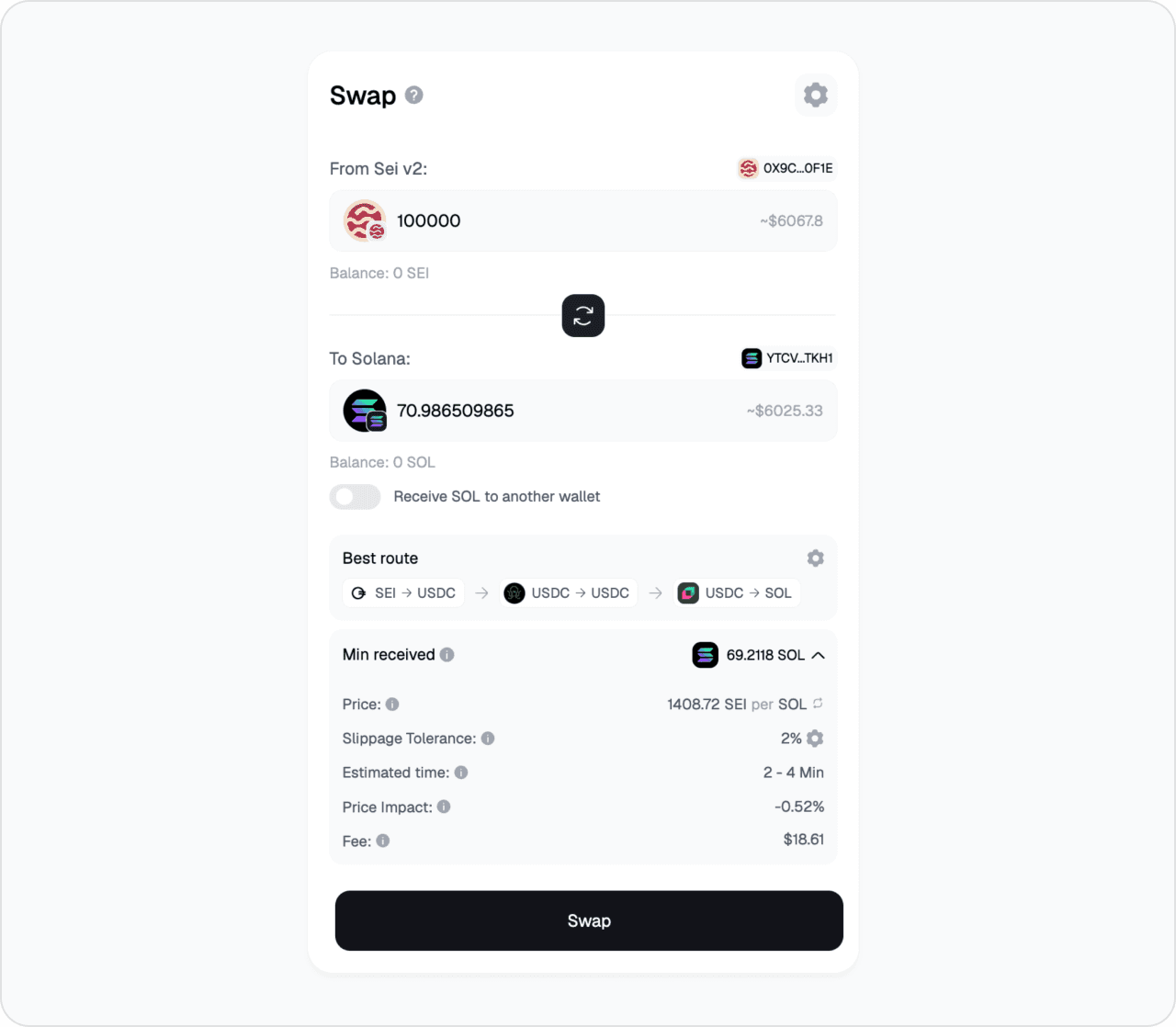
Example bridge: 100,000 SEI (~$6,068) from Sei v2 to native SOL on Solana via Symbiosis — a non-custodial liquidity meta-aggregator that delivers native SOL with no wrapped tokens. The figures below are an illustrative live Symbiosis quote; rates vary. Here's the flow:

  1. Connect your Sei v2 wallet. MetaMask (Sei v2 EVM), Compass Wallet, and Rabby work on the Sei v2 side; keep a little SEI for gas (~$0.01–0.05).

  2. Connect your Solana wallet. Phantom, Solflare, or Backpack — Symbiosis resolves your Solana address automatically once connected.

  3. Enter the amount. Source Sei v2/SEI, destination Solana/SOL. In this example, 100,000 SEI ≈ 71 SOL at ~1,409 SEI per SOL.

  4. Review the quote. Symbiosis shows the route (SEI → USDC → SOL), expected native SOL, fee (~$19), ETA (2–4 minutes), and price impact before you sign. 2% slippage tolerance is applied.

  5. Sign and confirm. Approve the transaction in your wallet; native SOL lands in your Solana wallet. Non-custodial throughout — your keys, your funds.

Bridge example in the Symbiosis app: Sei v2→Solana, 100,000 SEI → ~71 native SOL

About bridging SEI to Solana

Sei v2 → Solana is a corridor between two speed-obsessed chains: Sei’s parallelized EVM and Solana’s parallel SVM, both built for high-frequency, low-latency trading. Symbiosis routes SEI through stablecoin liquidity (SEI → USDC → SOL) to deliver native SOL — no wrapped tokens. It’s a natural path for traders consolidating from Sei’s orderbook DeFi into Solana venues like Jupiter and Raydium. Fully non-custodial — funds stay in your control until final delivery.

Other routes to Solana: Base to Solana, TON to Solana, USDC to Solana — or see the Solana bridge hub.

Real on-chain data sourced from Symbiosis routing layer and OpenClaw analytics, period 2026-02-20 → 2026-05-21. Statistics refreshed quarterly. Route performance subject to network conditions and liquidity depth on both chains.

Fees

Estimated fees

Approximate fees and bridge time based on historical averages, updated May 2026. Actual values may vary.

Amount

Amount

Amount

Receive

Receive

Receive

Fee + Gas

Fee + Gas

Fee + Gas

Time

Time

Time

1,000 SEI

1,000 SEI

0.73 SOL

0.73 SOL

~$0.75

~$0.75

~50 sec

~50 sec

10,000 SEI

10,000 SEI

7.26 SOL

7.26 SOL

~$6.24

~$6.24

~53 sec

~53 sec

50,000 SEI

50,000 SEI

36.29 SOL

36.29 SOL

~$33.84

~$33.84

~55 sec

~55 sec

100,000 SEI

100,000 SEI

72.56 SOL

72.56 SOL

~$69.56

~$69.56

~57 sec

~55 sec

Bridge now

Check your own quote

Above are averages — enter your amount below for a live quote with exact fees, route preview, and one-click bridge.

Benefits

Why Symbiosis

Best route aggregation

Symbiosis scans liquidity across multiple DEXs and chains via Octopools AMM, finding the optimal path for your bridge with minimal slippage.

Best route aggregation

Symbiosis scans liquidity across multiple DEXs and chains via Octopools AMM, finding the optimal path for your bridge with minimal slippage.

Best route aggregation

Symbiosis scans liquidity across multiple DEXs and chains via Octopools AMM, finding the optimal path for your bridge with minimal slippage.

Non-custodial & secure

Your assets stay in your wallet until the bridge executes. No custody, no KYC, no intermediaries. Audited smart contracts with an active bug bounty program.

Non-custodial & secure

Your assets stay in your wallet until the bridge executes. No custody, no KYC, no intermediaries. Audited smart contracts with an active bug bounty program.

Non-custodial & secure

Your assets stay in your wallet until the bridge executes. No custody, no KYC, no intermediaries. Audited smart contracts with an active bug bounty program.

Cross-VM coverage

Bridge across Ethereum, BNB Chain, Solana, Arbitrum, Polygon, TON, Tron, Bitcoin and 50+ more — both EVM and non-EVM chains in one route.

Cross-VM coverage

Bridge across Ethereum, BNB Chain, Solana, Arbitrum, Polygon, TON, Tron, Bitcoin and 50+ more — both EVM and non-EVM chains in one route.

Cross-VM coverage

Bridge across Ethereum, BNB Chain, Solana, Arbitrum, Polygon, TON, Tron, Bitcoin and 50+ more — both EVM and non-EVM chains in one route.

FAQs

Got questions?

Still have questions? Contact us and we’ll help you out.

01

How long does it take to bridge SEI to Solana?

Most SEI→Solana bridges complete in as fast as ~52 seconds, typically a few minutes. Time depends on Sei v2 block finality (~400 ms per block), intermediate stable-swap execution, and Solana's 400 ms slot time. Symbiosis bundles all steps—SEI → USDC → Solana USDC → native SOL—into a single user-facing transaction, so you don't wait for manual confirmations at each hop.


Most SEI→Solana bridges complete in as fast as ~52 seconds, typically a few minutes. Time depends on Sei v2 block finality (~400 ms per block), intermediate stable-swap execution, and Solana's 400 ms slot time. Symbiosis bundles all steps—SEI → USDC → Solana USDC → native SOL—into a single user-facing transaction, so you don't wait for manual confirmations at each hop.


02

What fees apply when bridging SEI to Solana?

Total fee on a $6,067 bridge (100,000 SEI → 70.98 SOL) is approximately $18.61 (0.31% of transaction value). This includes: (1) Sei v2 gas (~$0.01–0.05, negligible due to Sei's optimistic parallelization), (2) Solana transaction fees (~$0.0001 per instruction), (3) Symbiosis protocol fee, and (4) DEX swap slippage on the Solana side (USDC → SOL). If your Solana wallet is brand new and has never held SOL, a one-time rent-exempt activation of ~0.00089 SOL (~$0.075 at $84.82/SOL) applies to create the account. Slippage tolerance defaults to 2%; you can adjust it in the Symbiosis UI to control price impact on large orders.

Total fee on a $6,067 bridge (100,000 SEI → 70.98 SOL) is approximately $18.61 (0.31% of transaction value). This includes: (1) Sei v2 gas (~$0.01–0.05, negligible due to Sei's optimistic parallelization), (2) Solana transaction fees (~$0.0001 per instruction), (3) Symbiosis protocol fee, and (4) DEX swap slippage on the Solana side (USDC → SOL). If your Solana wallet is brand new and has never held SOL, a one-time rent-exempt activation of ~0.00089 SOL (~$0.075 at $84.82/SOL) applies to create the account. Slippage tolerance defaults to 2%; you can adjust it in the Symbiosis UI to control price impact on large orders.

03

Do I receive native SOL or wrapped SEI on Solana?

You receive native SOL, not wrapped SEI or any bridged token. Symbiosis routes your SEI through a 3-hop path: (1) swap SEI to USDC on Sei v2 DEXs, (2) bridge USDC from Sei to Solana via stablecoin liquidity pools, (3) swap USDC to SOL on Solana DEXs (Raydium, Orca, or others, depending on best rate). The final output is native SOL directly in your Phantom, Solflare, or Backpack wallet—ready to use for Solana DeFi, NFTs, staking, or gas fees without any unwrapping step.

You receive native SOL, not wrapped SEI or any bridged token. Symbiosis routes your SEI through a 3-hop path: (1) swap SEI to USDC on Sei v2 DEXs, (2) bridge USDC from Sei to Solana via stablecoin liquidity pools, (3) swap USDC to SOL on Solana DEXs (Raydium, Orca, or others, depending on best rate). The final output is native SOL directly in your Phantom, Solflare, or Backpack wallet—ready to use for Solana DeFi, NFTs, staking, or gas fees without any unwrapping step.

04

Which wallets work for bridging SEI to Solana?

On the Sei v2 side, use any EVM-compatible wallet: MetaMask (add Sei v2 network manually), Compass Wallet (native Sei support), or Rabby. Your Sei address will be in 0x.. format. On the Solana side, use Phantom, Solflare, Backpack, or Trust Wallet (Solana mode); your receiving address will be in base58 format (e.g., your Solana base58 address). You paste your Solana address into the Symbiosis UI during the bridge setup—no need to connect your Solana wallet to the bridge interface itself, keeping your Solana private keys isolated.

On the Sei v2 side, use any EVM-compatible wallet: MetaMask (add Sei v2 network manually), Compass Wallet (native Sei support), or Rabby. Your Sei address will be in 0x.. format. On the Solana side, use Phantom, Solflare, Backpack, or Trust Wallet (Solana mode); your receiving address will be in base58 format (e.g., your Solana base58 address). You paste your Solana address into the Symbiosis UI during the bridge setup—no need to connect your Solana wallet to the bridge interface itself, keeping your Solana private keys isolated.

05

Has Symbiosis ever lost user funds on the Sei → Solana route?

No. The Sei → Solana route has recorded 11 transactions with 100% success rate (zero failures, zero reverts) over the past 90 days. Symbiosis is non-custodial: you sign one transaction on Sei v2, and the protocol executes the cross-chain swap atomically via smart contracts and liquidity pools—funds never sit in a centralized bridge escrow.

No. The Sei → Solana route has recorded 11 transactions with 100% success rate (zero failures, zero reverts) over the past 90 days. Symbiosis is non-custodial: you sign one transaction on Sei v2, and the protocol executes the cross-chain swap atomically via smart contracts and liquidity pools—funds never sit in a centralized bridge escrow.

06

Why is transaction volume lower on the Sei → Solana route compared to other bridges?

Sei v2 launched in early 2024, and its parallel-EVM architecture is still gaining traction among developers and liquidity providers. The Sei → Solana corridor is a pioneering route connecting two non-EVM-equivalent high-performance chains (Sei's parallel execution and Solana's SVM). Current volume ($7,641 over 90 days, 11 tx) reflects early-stage adoption, but growth is accelerating: +147.8% quarter-over-quarter, with April volume at $3,237 and May already at $3,635 through May 21. As Sei v2 dApps mature and users seek Solana's deeper liquidity (Raydium, Orca, Jupiter aggregator), this route is positioned to scale. Low transaction count today means less competition for liquidity and often better rates for early movers.

Sei v2 launched in early 2024, and its parallel-EVM architecture is still gaining traction among developers and liquidity providers. The Sei → Solana corridor is a pioneering route connecting two non-EVM-equivalent high-performance chains (Sei's parallel execution and Solana's SVM). Current volume ($7,641 over 90 days, 11 tx) reflects early-stage adoption, but growth is accelerating: +147.8% quarter-over-quarter, with April volume at $3,237 and May already at $3,635 through May 21. As Sei v2 dApps mature and users seek Solana's deeper liquidity (Raydium, Orca, Jupiter aggregator), this route is positioned to scale. Low transaction count today means less competition for liquidity and often better rates for early movers.

07

Can I bridge USDC or other tokens from Sei to Solana, or only SEI?

You can bridge any token available on Sei v2 to Solana via Symbiosis. On-chain data shows 90.91% of past transactions used USDC (either native or USDC.n variant) as the source token, which Symbiosis then routes to SOL on Solana. If you hold SEI, Symbiosis swaps it to USDC on Sei first, then bridges. If you hold USDC on Sei, the route is more direct (USDC → Solana USDC → SOL). You can also choose to receive USDC on Solana instead of SOL—just select USDC as the destination token in the Symbiosis UI. The protocol auto-routes through the most liquid path regardless of your starting token.

You can bridge any token available on Sei v2 to Solana via Symbiosis. On-chain data shows 90.91% of past transactions used USDC (either native or USDC.n variant) as the source token, which Symbiosis then routes to SOL on Solana. If you hold SEI, Symbiosis swaps it to USDC on Sei first, then bridges. If you hold USDC on Sei, the route is more direct (USDC → Solana USDC → SOL). You can also choose to receive USDC on Solana instead of SOL—just select USDC as the destination token in the Symbiosis UI. The protocol auto-routes through the most liquid path regardless of your starting token.

08

What happens if Sei disables IBC before I bridge my Solana-USDC off Sei?

In early 2024, Sei Network announced plans to disable inbound IBC (Inter-Blockchain Communication) to reduce attack surface and optimize for its EVM execution layer. If you hold Solana-bridged USDC (USDCso) on Sei via IBC, you must bridge it back to Solana before IBC is disabled, or you may lose access. Symbiosis supports bridging USDCso (or any USDC variant on Sei) back to native USDC or SOL on Solana. The route is live and functioning (100% success rate). If you're unsure which USDC you hold, check the token contract in your Sei wallet—USDCso will show an IBC denom or legacy bridge origin. Act before Sei's governance finalizes the IBC shutdown to ensure seamless access to your funds on Solana.

In early 2024, Sei Network announced plans to disable inbound IBC (Inter-Blockchain Communication) to reduce attack surface and optimize for its EVM execution layer. If you hold Solana-bridged USDC (USDCso) on Sei via IBC, you must bridge it back to Solana before IBC is disabled, or you may lose access. Symbiosis supports bridging USDCso (or any USDC variant on Sei) back to native USDC or SOL on Solana. The route is live and functioning (100% success rate). If you're unsure which USDC you hold, check the token contract in your Sei wallet—USDCso will show an IBC denom or legacy bridge origin. Act before Sei's governance finalizes the IBC shutdown to ensure seamless access to your funds on Solana.

Two chains. One click

Bridge SEI from Sei v2 to native SOL — non-custodial, no wrapped tokens.

Bridge Solana banner