7 minute reading
What is a crypto swap and how does it work?
A crypto swap is the direct exchange of one cryptocurrency for another – say, trading USDT for ETH or swapping PEPE for POL – in a single transaction. Unlike traditional crypto trading, which relies on order books, centralized platforms, or finding a counterparty, crypto swapping is instant, self-custodial, and usually handled by smart contracts.
The key difference is that you don’t need to deposit funds into an exchange, wait for matching orders, or worry about KYC. A swap happens peer-to-contract – often in seconds – without leaving your wallet. That’s why instant crypto swap apps have become so popular.
At its core, a crypto swap lets you move from one token to another without touching fiat or bridging manually. It’s the fastest way to rebalance your portfolio, rotate into trending assets, or move into a stablecoin without using a centralized exchange.
For many, it’s simply the best way to swap altcoins.
What are crypto swaps used for?
Whether you’re a DeFi user or just looking to simplify your portfolio, token-to-token trades make life easier. You can quickly rebalance from BTC to ETH to USDC in a few taps. You can convert volatile coins into USDT, DAI, or USDC to hedge the market. You can even handle gas management by converting a bit of your balance into ETH or BNB to cover blockchain fees.
If you’ve ever asked how to swap crypto without fees adding up across platforms, this is how: use a platform that routes swaps efficiently and transparently in a single step.
How does a crypto swap work – and how is it different?
To understand how a crypto swap works, it's helpful to compare it to the alternatives. Trading, in the traditional sense, usually means logging into a CEX like Binance or Coinbase, placing an order, waiting for execution, and paying multiple fees – all while giving up custody and submitting to identity verification. That’s not ideal if you’re looking for a no-KYC crypto swap or trying to swap crypto without exchange involvement.
Bridging, on the other hand, moves a token from one chain to another. For example, USDC on Ethereum becomes USDC on Arbitrum – same token, different network. But, that doesn’t help if you want to actually switch assets.
Swapping is different. It changes both the token and, when needed, the chain. A good decentralized exchange swap lets you do both in one shot.
Take this example: you want to swap USDC on Ethereum for AVAX on Avalanche. Normally, you’d have to bridge, wait for confirmations, then go to a DEX and trade. But, with a platform like Symbiosis, you can swap crypto across chains with a single click – all from your wallet.
How to swap crypto in a few clicks
If you’re wondering how to swap crypto on mobile or desktop without jumping between platforms, here’s how it works on Symbiosis – one of the best crypto swap platforms.
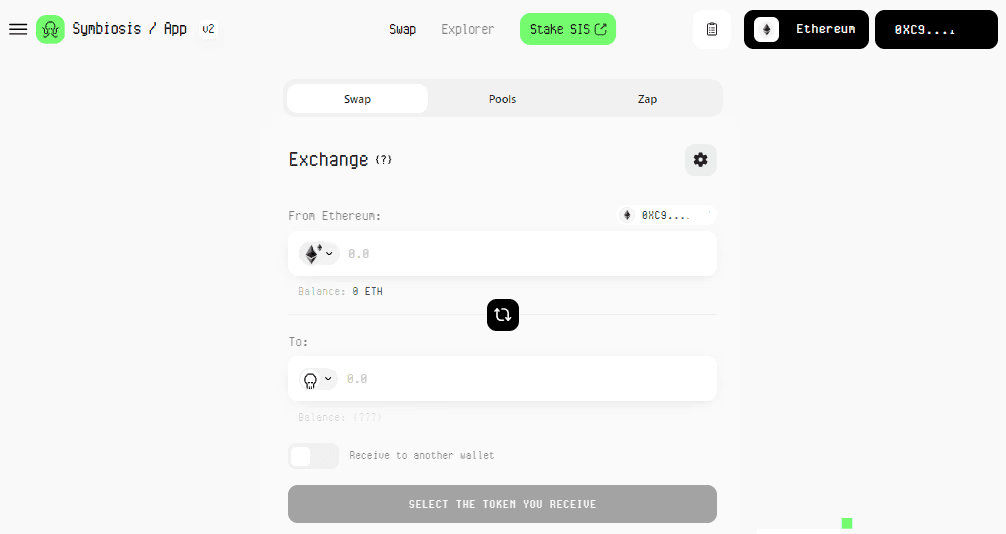
Connect your wallet. Go to symbiosis.finance, “Swap”, then click “Connect Wallet.” Symbiosis works with MetaMask, WalletConnect, and other self-custody wallets, so you keep full control of your funds. Just make sure your wallet is funded with the token you want to send and that you have enough of the network’s native token (ETH, POL, etc.) to cover gas fees.
Select the input token. Choose the token you’re starting with – your input token. It can be anything supported across Symbiosis’ 50+ networks, including Ethereum, Bitcoin, Tron, Solana, BNB Chain, Polygon, Avalanche and Arbitrum. If you're trying to swap Bitcoin for Ethereum or swap USDC to AVAX, this is where you start.
Select the output token. Now, pick what you want to receive – your output token. You can swap within the same chain or across blockchains. Symbiosis figures out the best route in real time, using smart contracts and bridge aggregation to make sure your swap crypto tokens transaction completes smoothly.
Enter the amount. Input how much you want to swap. You’ll see an instant preview of what you’ll get, how long it’ll take, and what you’ll pay in fees. For those asking what is the cheapest way to swap crypto, this real-time routing is what keeps costs low.
Review and confirm. Symbiosis will show you the route it’s using – including DEXes, bridges, and expected time. It also highlights slippage tolerance, gas costs, and total protocol fees. Once you’re happy, click confirm and approve the transaction in your wallet.
Watch it complete. After confirmation, you’ll see a progress bar as the swap confirmation is processed. Even if your swap moves across chains, Symbiosis handles everything behind the scenes. Once it’s done, your tokens will show up in your wallet – with a transaction ID you can verify on a block explorer like Etherscan.
By the way, if you’re wondering, is swapping crypto taxable? – in most jurisdictions, yes, token swaps can trigger a taxable event. Check your local crypto tax rules or track your crypto transaction history carefully.

Best crypto swap platforms compared
Platform | Cross-Chain Swaps | Aggregator (Best Price) | No KYC | Supported Chains | Key Strengths | Limitations |
Symbiosis | Yes (one-click) | Yes | Yes | 50+ (Bitcoin, Ethereum, Tron, Solana, BNB, Arbitrum, etc.) | Seamless cross-chain swaps, mobile-ready, no bridging | Fewer tokens than mega-DEXs in rare cases |
Uniswap | No | No | Yes | Ethereum, Base, Arbitrum, Optimism | Simple UI, deep ETH liquidity | No cross-chain, must bridge manually |
1inch | No (single-chain only) | Yes | Yes | Ethereum, BNB Chain, Polygon, etc. | Finds best on-chain rate, supports advanced routing | Still needs separate bridging for cross-chain |
Matcha | No | Yes | Yes | Ethereum, Polygon, BNB Chain | Clean interface, good for price discovery | No cross-chain, less support for newer chains |
Jumper.Exchange | Partial (via integration) | Yes | Yes | 10+ (incl. Ethereum, Avalanche, Fantom) | Bridge + swap combo (via LiFi), multi-step routing | Not as smooth as Symbiosis; more manual steps |
SimpleSwap | Yes (CEX-powered) | No | Yes | Bitcoin, Ethereum, XRP, more | CEX-level asset coverage, supports BTC, fiat | Custodial in parts, not purely De |
The best platform for cross-chain swaps
Fees, speed, and risks: what to expect
Where platforms like Uniswap or 1inch focus on single-chain swaps and leave you to handle bridging manually, Symbiosis does it all in one go. It aggregates decentralized exchanges and bridges across networks in real time, and executes everything through audited smart contracts. You don’t have to know which blockchain your target token is on. You don’t even need gas tokens for multiple chains. You just pick your input token, your desired output token, and confirm.
That’s what makes Symbiosis stand out. It’s one of the first platforms to make swap crypto across blockchains feel like a native feature of your wallet – especially if you’re using something like MetaMask.
It supports major EVM networks as well as Bitcoin, Tron, Solana and TON, and wraps the whole experience into a no-KYC crypto swap that just works.
Moreover, the entire flow can be done from your phone, making Symbiosis a serious contender for the best place to swap crypto instantly – especially for mobile-first users looking for an instant crypto swap app.
Fees
Even with the best tech, crypto swapping comes with some cost. But platforms like Symbiosis make those costs transparent – so you know what you’re paying before you confirm anything.
Every swap includes two key fees: one paid to the blockchain (gas), and one to the platform (protocol fee). Symbiosis displays both upfront – including multi-chain fees if you're swapping across networks. No hidden markups or surprise deductions – just a single total cost, clearly laid out. If you’ve ever asked how to swap crypto without fees piling up, this is how you get close: by using a system that finds the most efficient route and even auto-swaps to cover blockchain fees if you’re short on native tokens.
Speed
Most same-chain swaps complete in seconds. Cross-chain swaps can take a little longer – usually under two minutes – depending on congestion and the chains involved. Symbiosis routes each transaction through the fastest and safest available path, and shows real-time estimates before you commit. That kind of optimization is what makes it a low-fee crypto swap solution that doesn’t make you wait around.
Risks
Like everything in DeFi, swaps come with risks. Prices can shift between confirmation and execution (slippage), bridges can fail (especially lesser-known ones), and selecting the wrong token contract can lead to lost funds. Symbiosis minimizes these risks by using auto-slippage protection, real-time bridge monitoring, and a curated list of supported assets. The platform’s smart contracts are battle-tested and audited – giving you a safe way to swap crypto without relying on centralized platforms.
Also, you’ll get an automatic stablecoin refund in case, for whatever reason, the swap doesn’t get processed.

Cross-chain swaps: what they are and why they matter
Let’s say you want to swap USDC on Ethereum for AVAX on Avalanche. Traditionally, you’d need to bridge USDC across, wait for confirmations, then visit a DEX to complete the swap manually. That’s a multi-step headache – and one that exposes you to more slippage, more fees, and more room for error.
A cross-chain crypto swap changes that. With Symbiosis, you select USDC on Ethereum, choose AVAX on Avalanche, and hit confirm. That’s it. The platform handles the routing, bridging, and trading logic behind the scenes, using smart contracts and its decentralized exchange swap infrastructure.
So if you're wondering how to swap crypto across chains – or just want to swap stablecoins cross-chain in a single step – this is how it’s done.
Why it matters now
DeFi is no longer confined to Ethereum as major action now takes place on Layer 2s like Arbitrum and Optimism, on fast networks like Polygon and Base, and across alternative ecosystems like BNB Chain and Avalanche.
Yet, most DEXes still operate in silos – only letting users trade within the chain they’re on. That leaves users stuck, or forced to bounce between bridges, swap interfaces, and wallets.
Symbiosis breaks down those barriers. It’s one of the few platforms that supports swap crypto with MetaMask across networks, works with wallets that don’t natively support cross-chain logic, and doesn’t rely on wrapped assets or centralized custody.
For anyone managing assets in today’s multichain environment, cross-chain swaps are essential. Symbiosis offers one of the only user-friendly, fully decentralized ways to make them happen.

Share this: